Court Reports from Yesteryear

The petty court sessions of the 19th and early 20th century Ireland formed a cornerstone of the local judicial system. These sessions, typically held by justices of the peace (JPs), were central to rural and urban governance, providing a relatively accessible and cost-effective means of maintaining law and order within communities. The courts were key in addressing minor legal disputes and criminal matters. They dealt with a wide range of cases, from petty theft and public disturbances to civil disputes over debts and property. The courts had limited but significant powers in dealing with minor criminal and civil matters. These courts functioned as the lowest level of the judicial system in an Ireland under British rule. Their jurisdiction covered summary offenses, meaning cases were dealt with swiftly without a jury. In County Cork, there were regular petty court sessions in several locations – e.g. Cork City, Cobh, Midleton, Youghal and Castlemartyr. In the available records, which in entirety span over 100 years, there are 1,272 instances where a person from Ballymacoda was either a complainant or defendant. The vast majority of these – 1,179 – were heard at the petty sessions in nearby Castlemartyr and there is a wide range of complaints and offences captured. In this article, we will look at some of these court reports from yesteryear.

Some of the offences were extremely minor, and we may think somewhat laughable today. In a November 1879 case, Maurice McCarthy of Ballymacoda’s cause for complaint was ‘trespass of the defendants six cows in complainants garden at Ballymacoda on the 30th October 1879’. The defendant in the case is John Hennessy of Ballymakeagh, and he was ordered to pay McCarthy six shillings and pay his costs. There are actually numerous examples of this offence of trespass of cows in the records.

Another example of a minor offence by today’s standards of what we may see appear before a court is the case of Michael Walsh, Knockadoon. The complainant in his case, Michael Driscoll, also of Knockadoon, stated that the defendant ‘did deposit a quantity of seaweed on the public road leading from Ring to Knockadoon’ which was a danger to the public. There was no appearance by the two men on the date of the case, June 19th, 1885, so one can only postulate that they resolved their differences amicably.

Charges against Michael Walsh of Knockadoon for leaving seaweed on the road, Castlemartyr sessions, June 19th, 1885

One of the most common offences occurring in the records is individuals being fined for drinking on a Sunday or the publican being fined for having been open when they should have been closed. An example of this is the petty sessions held on October 15th, 1886. At these sessions Ellen Power was fined for ‘having her licensed premises at Ballymacoda open for the sale of intoxicating liquor on Sunday the 5th December 1886’. Along with the publican herself, John Donohoe of Gortavadda, William Aher of Ballymacoda, Mary Lynch of Ballymacoda, and Mary Brien of Ballyfleming were fined for being present in Power’s public house on the same day. Interestingly, Ellen Power was fined one shilling for being open and one shilling costs, while the four customers who were present in the pub were given a larger fine of five shillings each and one shilling costs.

Another example of this offence in the records is the publican John Bransfield, who was fined twenty shillings for having his premises in Ballymacoda open on Sunday March 23rd, 1890. Bransfield was before the court for the same offence again on December 23rd of the same year, and again in May 1891.
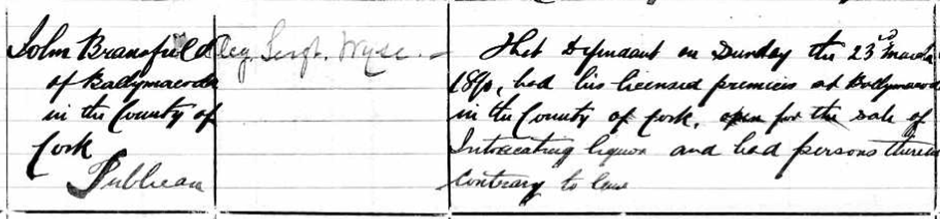
Charges against Publican John Bransfield, Castlemartyr sessions, April 1st, 1890

Another common occurrence in the court records is that of the defendant being drunk in public. An example of this is the case of Maurice Smiddy of Ballymacoda. At the October 18th, 1887, sessions in Castlemartyr, he was fined 1 shilling for being drunk in Ballymacoda on October 5th. He was also fined 1 shilling for costs. If he did not pay, he was to be confined to the County jail in Cork for 48 hours. The late 19th and early 20th century equivalent of drink driving is also common in the records. An example of this is the case of Michael Gumbleton of Knockadoon, who at the petty sessions held on November 2nd, 1897, was charged with being ‘found drunk in the charge of a horse and car on the public road at Yellowford’. He was fined 2/6 and ordered to be committed to Cork prison if he didn’t pay.

Something else that is hugely common in the records of the petty sessions are cases where a complainant is seeking money which they are owed. The Petty Sessions (Ireland) Act of 1851 allowed for the recovery of small sums, and cases were often resolved swiftly compared to higher courts. Judgments could result in payment orders or even seizure of goods if the debtor failed to pay. One name that comes up quite a bit in this context is William Aher from Ballymacoda, who was a shoemaker. Over the course of at least fifteen years there are numerous examples of Aher having to use the petty sessions to obtain what he was owed for the work he had completed. The effectiveness of the petty sessions in recovering debts for individuals and businesses was mixed. On one hand, the courts provided a relatively quick and inexpensive means for creditors, such as landlords, shopkeepers, and tradespeople like William Aher, to pursue unpaid debts. However, enforcement was a major issue. Many debtors were simply too poor to pay, rendering court rulings ineffective. Sheriffs were responsible for enforcing debt collection, but in cases where the debtor had no assets, the creditor was left without recourse. Historians such as Fergus Campbell (Land and Revolution: Nationalist Politics in the West of Ireland, 1891–1921) have noted that the system often favoured landlords and wealthier individuals, making it less effective for poorer claimants trying to recover money from equally impoverished debtors. As a result, while the petty sessions provided a legal avenue for debt recovery, their actual success depended heavily on the financial circumstances of the debtor and the efficiency of local enforcement mechanisms.

At the sessions of August 22nd, 1879, there are several cases relating to ‘unjust measures’ and ‘unjust weights’. Ballymacoda Publican Philip Walsh was fined for having ‘one unjust and illegal measure’ on his premises. The spirit measure in question also had to be forfeited. Publicans in nearby Mogeely, Michael Hartnett and Thomas Kenefick, were also fined on the same day for the same offence. Ballymacoda shopkeeper Martin O’Driscoll was fined the same day for having ‘two unjust weights’ in his possession. There are also defendants from Ladysbridge, James Thompson and William Coughlan who were fined for having unjust weights in their possession. The complainant in all these cases is the same – RIC Constable Terence Prendergast of Castlemartyr. One can only assume that he made it his business to visit local pubs and shops and perform checks on the measures and weights in question.

Example of a charge against a Ballymacoda Publican for having illegal spirit measures

People from Ballymacoda also show up in the records of other petty court sessions held throughout Cork. An example of this is John Cronin from Ballymacoda, who appeared at the Kinsale sessions on September 5th, 1896. He was listed as a ‘R. N. Reserve man’ (member of the Royal Navy Reserve) and was charged with being found drunk in the public street in Kinsale on August 22nd, 1896.

In tracing the stories of Ballymacoda’s inhabitants through the petty court sessions, we catch a glimpse of both the ordinary and extraordinary elements that shaped daily life in late 19th and early 20th century Ireland. These courts were more than just a forum for settling small-scale disputes; they played a pivotal role in preserving social order at a grassroots level. Offences ranged from the trivial – like trespassing cows or seaweed left on the road – to the more universally recognized issues of public drunkenness and not paying one’s debts. The petty sessions enabled ordinary people, such as shoemaker William Aher trying to recover unpaid bills, to seek redress without the expense and complexity of higher courts. Yet the system, under the governance of justices of the peace and local constabulary, reveals much about power balances in rural communities. Often, wealthier individuals and landlords had an advantage, both in bringing lawsuits and securing a favourable outcome. Meanwhile, the poorer segments of society – those who might have little to no assets – faced legal rulings they could hardly afford to honour. Still, the very existence of these sessions offered residents an alternative to vigilantism and personal retribution, encouraging negotiation and, at times, informal resolution.

Today, these records stand as a fascinating archive of local history. They illuminate how government, law, and ordinary people interacted in a rapidly changing Ireland. By examining cases from disputes over livestock to the regulation of alcohol, we gain not only a window into the practical workings of petty courts but also a richer understanding of the social fabric that held communities like Ballymacoda together.

References & Further Information

Ireland, Petty Session Court Registers, 1818-1919

Fergus Campbell, 2005, Land and Revolution: Nationalist Politics in the West of Ireland, 1891–1921
Spirits of the Past: The Historical Pub Trade in Ballymacoda Village

The Public Houses of Ballymacoda have long served as a welcoming haven for both residents and passing travellers, anchoring the social fabric of the area through every season and era. From the moment one crossed the threshold, the comforting glow of the lamplight spilling onto the street on a crisp evening beckoned, drawing people together to share both a freshly poured pint and the warmth of good company. For generations, the gentle hum of conversation, punctuated by raucous bursts of laughter combined with the faint aroma of peat from the fireplace to create an atmosphere that was both convivial and steeped in tradition. Indeed, these were not just places to enjoy a drink; before the age of modern conveniences, they were vital centres of social, economic, and cultural life, where neighbours and travellers alike exchanged news, stories, and customs. The public house likewise served as the gathering place where generations commemorated the passing of loved ones – a tradition that continues to endure today. In this article, we will delve into the historical roots of Ballymacoda’s pub trade, particularly from the mid-19th century onwards.

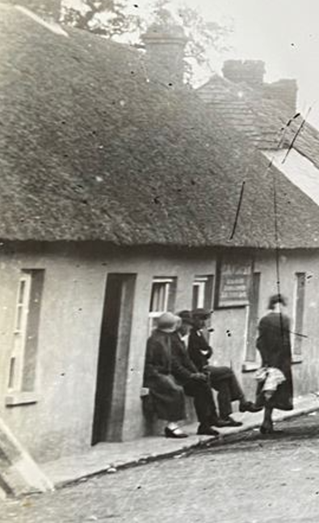
McLoughlin’s (“Mac’s), early 20th century

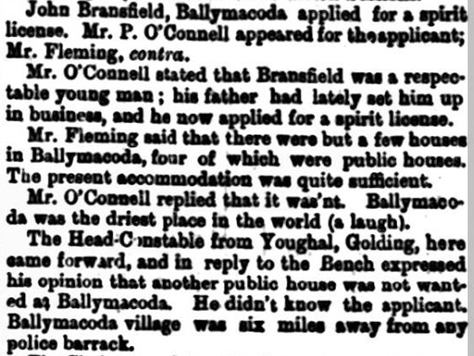
In the Cork Daily Herald on Saturday June 27th, 1868, we learn that John Bransfield has applied for a spirit license in Ballymacoda. Bransfield is described as ‘a respectable young man; his father had lately set him up in business’. There is some evidence to suggest that Bransfield came to Ballymacoda from nearby Midleton, and that he and his wife Margaret raised a large family here (at least 8 children according to the 1901 Census of Ireland records). In this report of his license application, we learn that there are already four public houses in the village, and that the Head R.I.C. Constable from Youghal, Constable Golding, opined that another public house was not wanted in Ballymacoda. It is also mentioned in this report that the nearest police barrack is six miles away, which confirms my previous research on the RIC in Ballymacoda that a barracks did not exist at this time. So, here we have a solid reference that there were four pubs in Ballymacoda in the 1860s. Bransfield’s license application on this occasion was adjourned. Later, in October 1868, the Cork Examiner mentions that the application had been refused.

Cork Daily Herald, Saturday June 27th, 1868

In April 1870, we learn from the Cork Examiner that Maurice Bransfield (likely the father of John) has now applied for a new license in Ballymacoda. Again, it is mentioned in the report of the court sessions that there are already four public houses in Ballymacoda and another is not needed. The application for a new license is once again rejected, with the resident magistrate, Mr. Dennehy, mentioning that ‘if one of the four gave up, the applicant would get a license’. What the magistrate described here would later become law under the Licensing (Ireland) Act, of 1902, a law that is still on the Irish statue book today – and means that no new licenses can be granted, only existing licenses transferred.

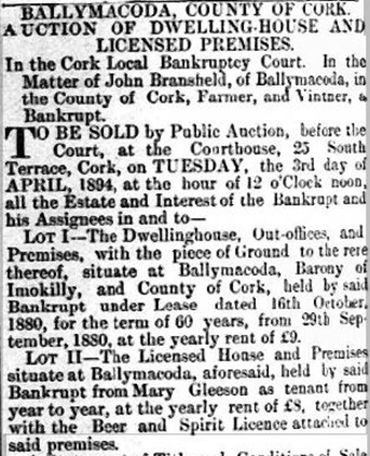
John Bransfield did eventually gain a license transfer – this is captured in the reporting from the Midleton Quarter Sessions in the Cork Constitution on November 1st, 1889. We can gain further insight into this through the many reports from 1893 and 1894 in relation to John Bransfield’s bankruptcy around that time. The notice of the auction of Bransfield’s holdings, which mentions him as a being a Vintner and a Farmer, that appeared in many newspaper reports of his insolvency at the time mentioned that he held a licensed premises from Mary Gleeson year to year for £8. However, the license, as we shall see, was the license from Power’s public house.

Cork Constitution, March 22nd, 1894

In a report of proceedings at the local bankruptcy court carried in the Cork Constitution on November 17th, 1893, we learn that the scenario of Bransfield’s license in Ballymacoda is complex. The license was originally held by Ellen Power, from whom Bransfield purchased it (the records of the Castlemartyr Petty Sessions confirm the existence of Power’s public house in Ballymacoda). However, as part of the license purchase, Mrs. Power was forgiven a sum of money she owed to Thomas S. Coppinger. Coppinger was a well-known and very wealthy merchant from nearby Midleton, and was the local agent of Cork city based brewery Beamish & Crawford. Further under the agreement, dated November 16th, 1888, John Bransfield agreed that he would only deal with Coppinger for porter and ale, and that he would keep his licensed premises in Ballymacoda as a going concern. As part of Bransfield’s bankruptcy, Coppinger was making a claim on the license and his solicitors contended that whoever took over the premises should now be bound to the agreement with Coppinger and only do business with him for porter and ale. The judge in the case, Judge Neligan, reserved judgement, commenting what seemed like his dubiousness ‘that the house must always be used as a public house, and that the covenant should be operative, say, for fifty or a hundred years, long after Bransfield had ceased to exist’. Unfortunately, I have not been able to find further contemporaneous reports that confirm the judge’s final decision, but nonetheless this is very interesting.

The records of the Castlemartyr Petty Sessions are a valuable source of information with regards the public houses of Ballymacoda. These court sessions of the 19th and early 20th century Ireland formed a cornerstone of the local judicial system. These sessions, typically held by justices of the peace (JPs), were central to rural and urban governance, providing a relatively accessible and cost-effective means of maintaining law and order within communities. Several court reports from the records of the Castlemartyr Petty Sessions from the 1870s tell us that the public houses in Ballymacoda at that time were: Power’s, Cotter’s, Gumbleton’s and Walsh’s. There are many examples listing offences relating to public houses in Ballymacoda, which we can use to confirm their existence at specific times. An example of this is the petty sessions held on October 15th, 1886. At these sessions Ellen Power was fined for ‘having her licensed premises at Ballymacoda open for the sale of intoxicating liquor on Sunday the 5th September 1886’. Along with the publican herself, John Donohoe of Gortavadda, William Aher of Ballymacoda, Mary Lynch of Ballymacoda, and Mary Brien of Ballyfleming were fined for being present in Power’s public house on the same day. Interestingly, Ellen Power was fined one shilling for being open and one shilling costs, while the four customers who were present in the pub were given a larger fine of five shillings each and one shilling costs.

Another example of this offence in the records is the aforementioned publican John Bransfield, who was fined twenty shillings for having his premises in Ballymacoda open on Sunday March 23rd, 1890. Bransfield was before the court for the same offence again on December 23rd of the same year, and again in May 1891.

Charges against Publican John Bransfield, Castlemartyr sessions, April 1st, 1890

The Guinness Trade Ledgers (1860-1960) are another good source of information relating to public houses in Ireland. These ledgers were meticulously maintained by Guinness, capturing the essence of their sales and personnel records over a century. Entries were often handwritten during the earlier years, and as the years progressed, the ledger entries were typed. The entries for 1913-1918 which summarize the deliveries to Ballymacoda show three public houses receiving deliveries of Guinness during those years – E. A. McLoughlin, John O’Donoghue, and James Gumbleton. Interestingly there are no orders at all for 1913 in the ledgers, and I can find no records in the ledgers at all before 1914. Were all the pubs ‘Beamish houses’ before then I wonder? As we have seen when discussing John Bransfield earlier, we know that Thomas Coppinger acting as local agent of Beamish and Crawford had exclusivity in at least one pub in Ballymacoda.

In 1924, the ledger entries for Ballymacoda reveal deliveries of Guinness to Gumbleton’s, McLoughlin’s, and O’Donoghue’s pubs. Cotter’s appears from the 1925 ledger onwards which perhaps means that they didn’t stock Guinness before that. The quantities in the ledger entries are listed as ‘Hhds.’, short for ‘Hogshead’, which was a large wooden cask. According to Guinness, the capacity of one Hogshead was approximately 416 pints.

1924 orders of Guinness to public houses in Ballymacoda

To summarize our journey up to this point:

  • In the 1860s and 1870s we know based on newspaper reports of the license aspirations of John Bransfield that there were four public houses in Ballymacoda.
  • Combined with the records of the Castlemartyr Petty Court Sessions, we can ascertain that these were: Power’s, Cotter’s, Gumbleton’s and Walsh’s.
  • In the late 1880s John Bransfield acquired Powers from licensee Ellen Power.
  • The Guinness Trade Ledgers from 1913 tell us that there were deliveries of Guinness to O’Donoghue’s, Gumbleton’s and McLoughlin’s. Cotter’s also existed at this time but may not have stocked Guinness up to 1924 when those entries first appeared in the Guinness Trade Ledgers, or an alternative theory is that Cotter’s was closed and not operating as a public house for a period of time.
O’Donoghue’s, early 20th century

In terms of how the public houses of the 1860s evolved into the 20th and 21st centuries, it progressed as follows:

  • Cotter’s → Finn’s – the Finn family bought Cotter’s around 1984 and then opened it up as Finn’s Tavern in April 1986.
  • Walsh’s → McLoughlin’s → Daly’s – There are no McLoughlin’s living in Ballymacoda in the 1901 census. Edward McLoughlin Snr. came to Ballymacoda as an R.I.C. Constable (he was born in Co. Roscommon) – his entry in the 1911 census, showing him living in Ballymacoda mentions his occupation as ‘retired policeman’. In the same 1911 census data, his wife, Elizabeth McLoughlin’s occupation is listed as ‘publican’. This indicates that sometime between 1901 and 1911 the McLoughlin family bought Walsh’s public house. Dave Daly bought McLoughlin’s in 1990, and it remained open up until around 2010.
  • Power’s → Bransfield’s → O’Donoghue’s – I would posit that O’Donoghue’s may have acquired what was Power’s/Bransfield’s during the bankruptcy of John Bransfield. O’Donoghue’s stopped trading in 2011.
  • Gumbleton’s → Hopkin’s – Gumbleton’s became Hopkin’s and operated until the 1990s.
A Beamish delivery to Cotter’s

All but one public house are now sadly closed – since 2011, Finn’s Tavern has been the only public house in Ballymacoda. From these historical glimpses, it is clear that Ballymacoda’s public houses, which were once as numerous as the lamplights guiding travellers through the village, have evolved considerably over the centuries, transforming in name, ownership, and allegiance to breweries. Yet, through all the changes in licensing laws, economic fortunes, and personal family legacies, one abiding tradition remains: the central role of the pub as a communal gathering place, where residents mark life’s milestones, exchange stories, and nurture the tight bonds that define this close-knit community.

Though only Finn’s Tavern now stands to carry forward these customs, its continued presence in the heart of Ballymacoda ensures that the spirit of warm hospitality, once shared by many public houses, will hopefully endure for generations to come.

Gumbleton’s, early 20th century

References & Further Information

Cork Daily Herald, Saturday June 27th, 1868

1901 & 1911 Census of Ireland Records

Cork Examiner, Tuesday, October 6th, 1868

Cork Constitution, November 1st, 1889, Mention of license transfer to John Bransfield in report of Midleton Quarter Sessions

Cork Constitution, November 17th, 1893, Details on John Bransfield’s Bankruptcy

Cork Constitution, March 22nd, 1894, Details on John Bransfield’s Bankruptcy

Ireland, Petty Session Court Registers, 1818-1919

Ireland, Guinness Trade Ledgers, 1860-1960

Credit to Elizabeth and Gillian Hyde for the photograph of the Beamish delivery to Cotter’s