As this marks the 40th article I have written for the Ballymacoda History Project, I want to take a moment to sincerely thank everyone who has read, shared, commented on, or supported the project so far. Your interest and encouragement have helped keep these local stories alive, and I’m very grateful to all who continue to follow along.
All previously published articles can be found here.
As I look over at Capel Island from my garden as I write this, it is hard not to see it as part of the ordinary landscape of home. It sits there quietly off Knockadoon, familiar to everyone along this stretch of the East Cork coast. In the nineteenth century in particular, Capel Island was often referred to as Cable Island – it is even referred to as such in Samuel Lewis’s A Topographical Dictionary of Ireland (1837). Likewise, in many newspaper reports of the time, this is the case. And 193 years ago, that name was attached to one of the worst local sea tragedies I have yet come across.
This tragic story of March 1833 survives in scattered newspaper reports. They do not give us everything we would like to know. They do not give us the names of the dead. They do not even agree on every detail. But they do agree on one terrible central fact: fifty-two people were reported drowned near Capel Island in March 1833. The victims appear to have been local working people travelling by boat between Youghal and Ballycotton.
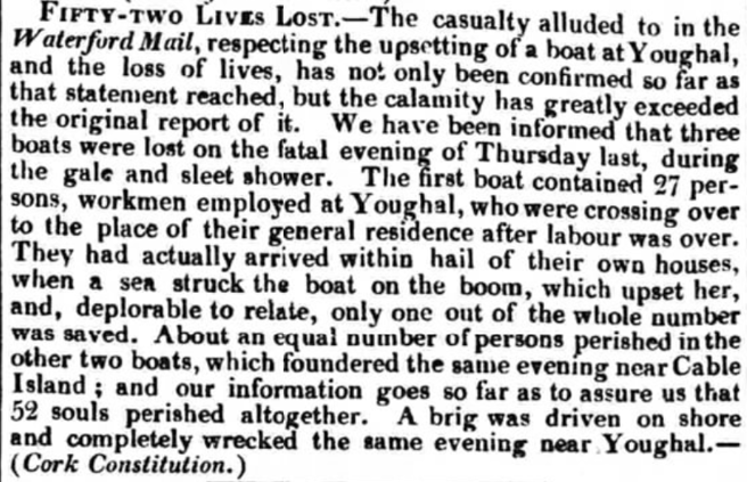
A report in the Belfast News-Letter, on Tuesday March 26th, 1833, was headed:
“CASUALTY AT YOUGHAL.—FIFTY-TWO LIVES LOST.”
The Belfast article was a reprint from the Cork Constitution, and itself referred to an earlier report which carried in the Waterford Mail. According to this version, the original account had underestimated the scale of the tragedy. The report said three boats were lost “during the gale and sleet shower.” The first boat, it stated, carried 27 persons, described as workmen employed at Youghal. They were crossing back after their labour was over for the day, apparently returning towards their homes across the bay. The most haunting detail in the report is that they had arrived “within hail of their own houses” when a wave struck the boat, overturned her, and only one person survived. The same report says that about an equal number of people perished in two other boats which foundered near Cable Island, bringing the total to fifty-two souls. That account gives us a vivid scene: rough weather, sleet, working people coming home after their days work was done, boats near the shore, and disaster within sight of safety.
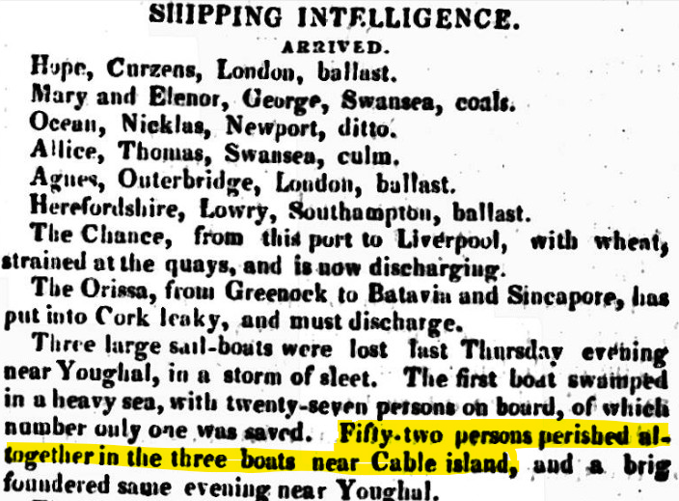
A second contemporary version appeared across the Atlantic in the Centreville Times and Eastern-Shore Public Advertiser, Maryland, on May 14th, 1833. Its report was headed “Dreadful Accident” and was dated Dungarvan, March 19th. This account said that the loss happened on a Saturday, when two market boats upset near Cable Island. It reported that 52 “human beings, men and women” drowned while returning home to the neighbourhood of Ballycotton after going to Youghal “to get gold or bank notes.” It added that the disaster left a number of orphans “in a state of wretchedness and starvation.” This version is similar in the death toll but differs in the number of boats and in the description of the passengers. Here they are not described as workmen, but as men and women returning from Youghal to the Ballycotton neighbourhood.
Another American reprint, the Richmond Palladium (Weekly) of 4 May 1833, also carried the story and refers to 52 people being lost near Cable Island. The newspaper text available online includes the detail that one boat contained workmen employed at Youghal, again linking the tragedy to labourers returning from town. A further reprint in the American Beacon and Norfolk and Portsmouth Daily Advertiser, 24 April 1833, appears to have carried both the Waterford Mail/Cork Constitution version and the “fifty two souls perished altogether” wording.
What can we say with confidence?
The surviving newspaper reports allow us to say the following with reasonable confidence:
- A major boating disaster occurred near Cable / Capel Island, off Knockadoon Head, in mid-March 1833.
- The reported death toll was fifty-two people.
- The people lost were travelling between Youghal and the Ballycotton side of the bay, or at least towards the “neighbourhood of Ballycotton.”
- The accident happened in bad weather, at least according to the Cork/Belfast newspaper versions, which mention gales and sleet showers.
- The victims were ordinary local people: workmen, marketgoers, men and women. No source found so far gives a list of names.
What remains uncertain is also important. The reports disagree on whether two boats or three boats were lost. They disagree on whether the people were mainly workmen returning from labour, or men and women returning from market business in Youghal.
Why were they crossing there?
The reports do not explain the journey in detail, but the geography makes sense. Before modern roads and reliable transport, the water was often the quickest route between the town of Youghal and coastal communities around Ballymacoda, Knockadoon, Ballycotton, and the East Cork coast. The 1833 account of “market boats” suggests that ordinary movement across the bay was part of local economic life.
The odd phrase in the Dungarvan report — that the passengers had gone to Youghal “to get gold or bank notes” — is especially intriguing. It may point to money, wages, market exchange, or banking arrangements, but the available reports do not explain it. Without further evidence, it is best left as an open question.
A dangerous coast
The tragedy fits into a wider nineteenth-century pattern: this was a dangerous stretch of coast. Irish Lights records that from 1828 to 1846 there were repeated requests from merchants, ship owners, masters, Cork Harbour Board, and the Admiralty for a lighthouse on Capel Island off Knockadoon Head. As we have seen previously when I have written of the coastguard in Ballymacoda, there was a coastguard presence in Ballymacoda from at least the 1820s.
A lighthouse was eventually begun on Capel Island in 1847, but the plan changed after the wreck of the paddle steamer Sirius on Smith’s Rock near Ballycotton. The Capel Island works were suspended, and the unfinished tower was left as an unlit beacon. Ballycotton and Mine Head lights were lit on June 1st, 1851, and Youghal followed in February 1852.
Remembering the unnamed
The saddest part of this story is that the victims are, for now, unnamed. Fifty-two deaths would have devastated families across the district. The contemporary report’s reference to orphans left in poverty gives a glimpse of the aftermath, but not the names, homes, or burials of those who died.
I conducted an intensive search of Historic Graves and other local graveyard records for any possible trace of those lost in the disaster. I checked the likely burial grounds around Ballymacoda, Ballycotton, Youghal, Killeagh and the surrounding areas, looking for deaths in March 1833, references to drowning, boat accidents, Capel Island, Cable Island or Youghal Bay. No confirmed grave or named victim has yet emerged. A few burials from 1833 were found, including one close in date, but none mention the disaster or give enough evidence to link them to it. Further research may yet uncover parish burial records, inquest records, relief efforts, or names of the drowned. Until then, the record we have is stark enough: in March 1833, near Capel Island, fifty-two people were reported lost within sight of home.
This tragedy deserves to be remembered, not only because of the number of lives lost, but because those lives were part of the ordinary world of our coast — people travelling for work, business, and home across waters they knew well. The sea has always shaped life around Ballymacoda, Ballycotton, Knockadoon and Youghal Bay, but on that day in March 1833 it brought terrible loss.
And so, as Capel Island sits quietly in the distance today, it is worth remembering that for some families in March 1833, that familiar view became the scene of unimaginable loss. We may not yet know their names, but we know enough to pause. Fifty-two people set out across the water and never made it home. Their story deserves its place in the memory of our coast.
References & Further Information
Lewis, Samuel. A Topographical Dictionary of Ireland. London: S. Lewis and Co., 1837.
Belfast News-Letter, Tuesday 26 March 1833, p. 4, “Casualty at Youghal.—Fifty-Two Lives Lost.” User-supplied clipping; report copied from the Cork Constitution, referring to the Waterford Mail.
Centreville Times and Eastern-Shore Public Advertiser, Queen Anne’s County, Maryland, 14 May 1833, “Dreadful Accident.”
Richmond Palladium (Weekly), 4 May 1833, p. 3, online newspaper search result for Cable Island report.
American Beacon and Norfolk and Portsmouth Daily Advertiser, 24 April 1833, p. 2, online newspaper search result for Youghal/Cable Island report.
National Parks and Wildlife Service, Capel Island and Knockadoon Head Nature Reserve.
Commissioners of Irish Lights, Ballycotton Lighthouse history.