
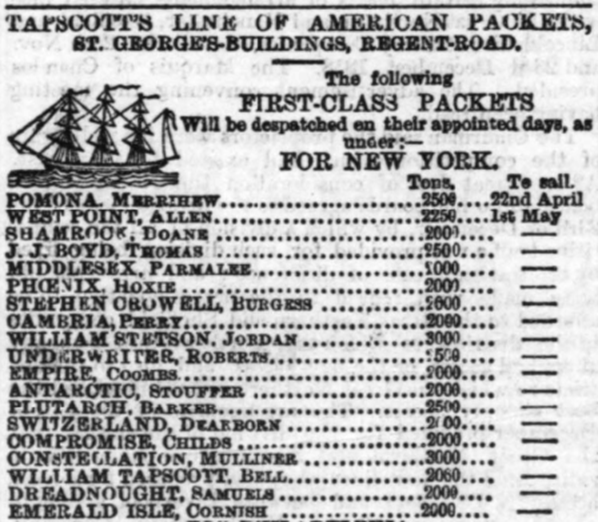
“On the morning of Sunday last, the 12th, two bodies were found floating – one that of a man off Barry’s Cove, in Youghal Bay, and the other that of a female, off Sea Mount in Ballycotton Bay. Henry Barry, Esq., coroner, held inquests on both. On the person of the man were found two and a half sovereigns, and nineteen shillings and sixpence in silver, a bunch of keys, and, in an old pocketbook, some papers, among them a docket, dated Liverpool, the 25th of April, stating the payment by John Miller, for self and wife, of passage to New York, per ship Pomona, and also for the sum of £2 12s for their transit from that city by railway and steamboat to Hamilton. The parts of the body exposed were quite deprived of flesh. Mr. Barns, of the coast-guard station at Knockadoon, sent an immediate account to the police authorities at Youghal, and the sub-inspector had a coffin sent off. The body is interred in the Ballymacoda burial ground. The body of the female was deprived of one arm and a foot, and the parts exposed were without any flesh; on the remaining foot was a lace boot of a strong texture; the inner garments were of a very good kind; no money or valuables were found on this person. The body is interred in the Kilmahon burial ground. Verdicts in accordance with the facts presented were found, and that – ‘They were supposed to have met their death by drowning on the night of April 26th (sic) last, by the wreck of the ill-fated ship Pomona on the Blackwater Bank, off the coast of Wexford’.”
So reads this excerpt from an article carried in the Dublin Evening Mail newspaper on Monday June 20th, 1859. It must have been an awful sight for whomever found the body of John Miller that Sunday morning in Barry’s Cove, very likely local fishermen out of Knockadoon. John Miller had set out from Liverpool on the Pomona, travelling with this wife, likely in the hope of making a new life for themselves in America, but had ended up dead and ‘interred in the Ballymacoda burial ground’ (the Hill Cemetery).
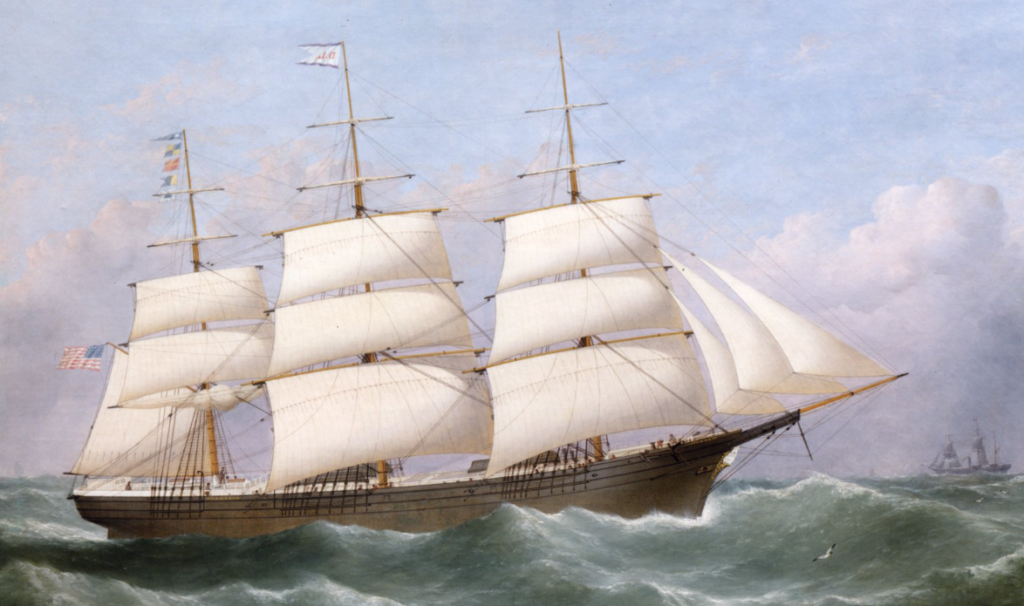
Firstly, let us set the scene for how John Miller met his death – the sinking of the ship Pomona. The sinking of this American clipper ship in late April 1859 was a major maritime tragedy off the Wexford coast, when the vessel ran onto the Blackwater Bank near Ballyconigar during severe weather. The ship was travelling from Liverpool to New York, carrying mostly Irish emigrants making their way to the new world to seek a better life.
Stranded on the treacherous sandbank and exposed to heavy seas, the ship became helpless, eventually breaking up as waves swept across her decks. Despite efforts from the shore and the involvement of the lifeboat service, the conditions made rescue extremely difficult, resulting in a heavy loss of life. According to the official Board of Trade inquiry, out of the 448 passengers and crew aboard, only 24 survived. 19 of those were crew members. The disaster shocked coastal communities in Wexford and beyond, and it remains one of the most harrowing shipwrecks recorded along that stretch of the Irish coast – the Titanic disaster of its time.
After the sinking of the ship, bodies continued to wash up along the east coast and faraway shores in the following weeks and months. Some of the victims were still being found as late as December 1859, as currents continued to carry remains ashore. This prolonged recovery likely added to the tragedy’s impact on local communities, with many of the recovered bodies buried in local graveyards. The body of John Miller, who was referenced in the aforementioned article snippet which carried in Dublin Evening Mail, was one of these bodies that washed up later, in June, nearly two months after the sinking, in Barry’s Cove, Knockadoon, and was buried in the Hill Cemetery.
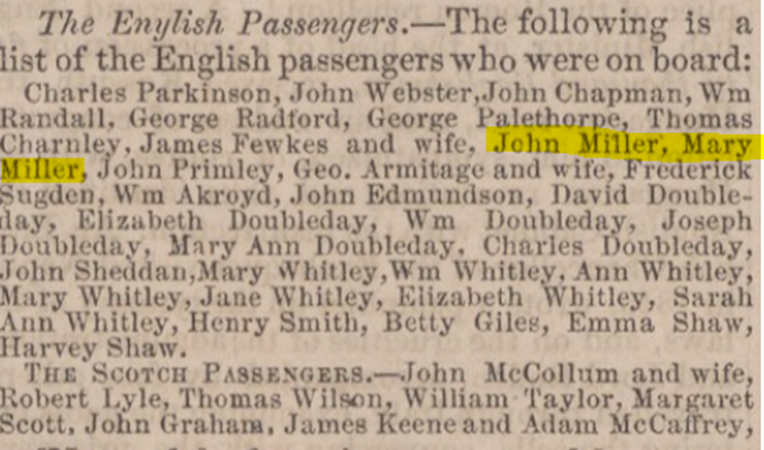
I began my research by trying to confirm that a man named John Miller had sailed aboard the Pomona. The article in the Dublin Evening Mail gives us a first clue – it mentions that in his pocket was proof of payment for passage for himself and his wife to America. After some searching, I found confirmation that there was a man named John Miller aboard the Pomona – in an article in the Boston Pilot on 28th May 1859 entitled ‘Loss of the Ship Pomona’, which was a reprint of an article which appeared in the Wexford Constitution. In addition to giving the details of how the wreck occurred, passenger lists were also provided in this article. In the small list of English passengers – the majority of passengers were Irish emigrants – we find the name of John Miller, and a name for his wife – Mary.
In many nineteenth-century shipwrecks, the dead were never identified, their names and stories disappearing with them beneath the sea. That John Miller could be identified at all was due largely to the remarkable survival of the papers found in his pocketbook when his body was recovered at Barry’s Cove. Without these fragile documents, it is likely he would have been buried simply as an unknown victim of a wreck, his connection to the Pomona perhaps lost forever.
Among the most poignant details recovered from John Miller’s body was the discovery of a docket showing payment not only for passage aboard the Pomona from Liverpool to New York, but also for onward travel by railway and steamboat to Hamilton. This small surviving document offers a glimpse into the journey John and wife Mary had planned for themselves. Like many emigrants of the 1850s, they were not simply travelling aimlessly to America, but following an organised route toward a specific destination where work, family connections, or the hope of a more secure future may have awaited them. The fact that arrangements had already been made for the next stage of their journey makes the tragedy all the more heart-breaking. The Millers had not only dreamed of a new life — they were already on the road toward it when the Pomona was lost.
Further tracing the death of John Miller from the Pomona disaster has been difficult because shipwreck records from mid-19th-century Ireland and Britain were often incomplete, inconsistent, or never formally created at all. Although the Pomona sank in 1859 with heavy loss of life, this occurred before the beginning of universal civil death registration in Ireland in 1864, meaning no standard Irish death certificates exist for the victims. Many emigrant passengers were recorded only by name on newspaper casualty lists, while official ‘Deaths at Sea’ registers frequently omitted steerage passengers or failed to survive in full. In cases where bodies later washed ashore, identification depended on local inquests, parish burials, or newspaper reports, many of which are now lost, fragmented, or remain undigitized in local archives. However, we do know from the newspaper excerpts that an inquest was held on the body found in Barry’s Cove, mentioned as having been conducted by Henry Barry Esq. who was indeed the coroner for the east riding of County Cork at that time. We can also confirm from these reports that the recorded verdict was death by drowning as mentioned in the earlier excerpt we have seen from the Dublin Evening Mail.
What was lost in the sinking of the Pomona cannot be measured simply in numbers. Each emigrant on board carried with them the weight of hope — hopes of steady work, of land or security, of families raised far from famine and hardship. They were men and women who had already endured hardship at home and had made the difficult decision to leave Ireland in search of opportunity in America. In another world, some might have become farmers, labourers, craftsmen, shopkeepers, or parents whose children would never know the poverty they themselves had known. Instead, those futures were extinguished on the Blackwater Bank, leaving behind only grief, unanswered questions, and communities forced to mourn lives not yet lived. The wreck of the Pomona robbed not only individuals of their chance at a new beginning, but generations of the contributions they might have made, both in America and in the memories of those who waited in vain for news from across the Atlantic.
There is something especially tragic in the story of John and Mary Miller because, beyond the loss of their lives in the Pomona disaster, so little of their lives now survives in the historical record. We do not know with certainty where they were born in England, what lives they led before leaving home, or what hopes drew them aboard an emigrant ship bound for America in 1859. They may have been seeking opportunity, escape from hardship, or the promise of a better future, but whatever dreams they carried with them were lost in the wreck off the Wexford coast. Even the details of their deaths survive only in fragments, scattered across newspaper reports of the time. Like countless ordinary emigrants of the nineteenth century, they slipped quietly from history, leaving behind little more than their names.
Yet the story that John Miller’s body was carried ashore near Knockadoon and buried in the Hill Cemetery gives our local community a connection to the tragedy of the Pomona. For that reason, it would be fitting to mark the connection with a plaque or memorial, not only in memory of John Miller, but also as a tribute to the hundreds of forgotten emigrants whose lives, ambitions, and futures vanished with the Pomona.
Perhaps this is the true value of local historical research — not merely preserving dates and events, but restoring forgotten people to memory.
References & Further Information
There are numerous online resources available on the Pomona. There is also a ballad written by Patrick Michael Karnahan (The Ballad of the Ship Pomona) and performed by him and the Black Irish Band which commemorates the Pomona, this is available on Spotify & YouTube.
Dublin Evening Mail, Monday 20 June 1859, Page 4, Wreck of the Pomona
The Unfortunate Pomona, The Irishman – Saturday 25th June 1859
Pomona, entry in Wikipedia
The Boston Pilot, Volume 22, Number 22, 28 May 1859Liverpool Daily Post – Wednesday 20 April 1859