The Body at Barry’s Cove: Remembering a Victim of the Pomona Tragedy

“On the morning of Sunday last, the 12th, two bodies were found floating – one that of a man off Barry’s Cove, in Youghal Bay, and the other that of a female, off Sea Mount in Ballycotton Bay. Henry Barry, Esq., coroner, held inquests on both. On the person of the man were found two and a half sovereigns, and nineteen shillings and sixpence in silver, a bunch of keys, and, in an old pocketbook, some papers, among them a docket, dated Liverpool, the 25th of April, stating the payment by John Miller, for self and wife, of passage to New York, per ship Pomona, and also for the sum of £2 12s for their transit from that city by railway and steamboat to Hamilton. The parts of the body exposed were quite deprived of flesh. Mr. Barns, of the coast-guard station at Knockadoon, sent an immediate account to the police authorities at Youghal, and the sub-inspector had a coffin sent off. The body is interred in the Ballymacoda burial ground. The body of the female was deprived of one arm and a foot, and the parts exposed were without any flesh; on the remaining foot was a lace boot of a strong texture; the inner garments were of a very good kind; no money or valuables were found on this person. The body is interred in the Kilmahon burial ground. Verdicts in accordance with the facts presented were found, and that – ‘They were supposed to have met their death by drowning on the night of April 26th (sic) last, by the wreck of the ill-fated ship Pomona on the Blackwater Bank, off the coast of Wexford’.

So reads this excerpt from an article carried in the Dublin Evening Mail newspaper on Monday June 20th, 1859. It must have been an awful sight for whomever found the body of John Miller that Sunday morning in Barry’s Cove, very likely local fishermen out of Knockadoon. John Miller had set out from Liverpool on the Pomona, travelling with this wife, likely in the hope of making a new life for themselves in America, but had ended up dead and ‘interred in the Ballymacoda burial ground’ (the Hill Cemetery).

Firstly, let us set the scene for how John Miller met his death – the sinking of the ship Pomona. The sinking of this American clipper ship in late April 1859 was a major maritime tragedy off the Wexford coast, when the vessel ran onto the Blackwater Bank near Ballyconigar during severe weather. The ship was travelling from Liverpool to New York, carrying mostly Irish emigrants making their way to the new world to seek a better life.

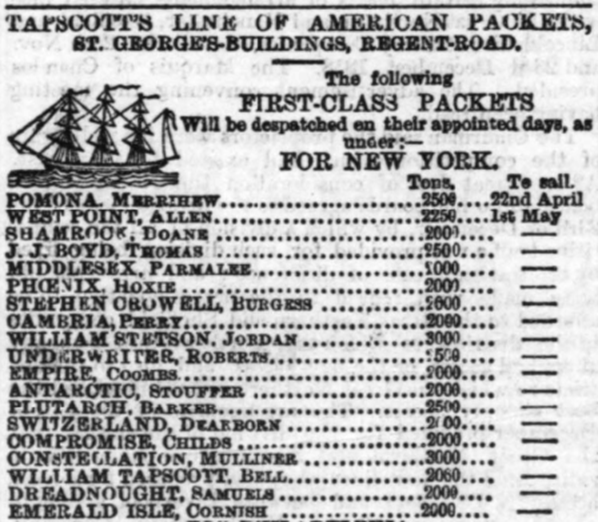
Advertisement of the Pomona planned sailing to New York, from the Liverpool Daily Post, April 20th, 1859. The name ‘Merrihew’ after the ship’s name refers to Captain Charles Merrihew who commanded the ship

Stranded on the treacherous sandbank and exposed to heavy seas, the ship became helpless, eventually breaking up as waves swept across her decks. Despite efforts from the shore and the involvement of the lifeboat service, the conditions made rescue extremely difficult, resulting in a heavy loss of life. According to the official Board of Trade inquiry, out of the 448 passengers and crew aboard, only 24 survived. 19 of those were crew members. The disaster shocked coastal communities in Wexford and beyond, and it remains one of the most harrowing shipwrecks recorded along that stretch of the Irish coast – the Titanic disaster of its time.

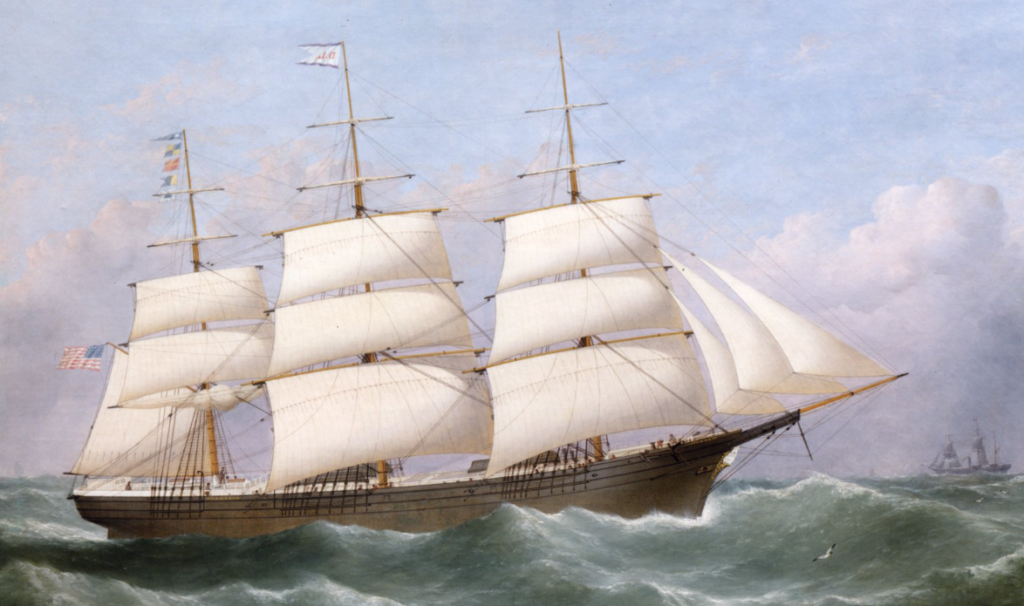
The Pomona, painted by English maritime artist Samuel Walters, 1858, the year before the tragedy

After the sinking of the ship, bodies continued to wash up along the east coast and faraway shores in the following weeks and months. Some of the victims were still being found as late as December 1859, as currents continued to carry remains ashore. This prolonged recovery likely added to the tragedy’s impact on local communities, with many of the recovered bodies buried in local graveyards. The body of John Miller, who was referenced in the aforementioned article snippet which carried in Dublin Evening Mail, was one of these bodies that washed up later, in June, nearly two months after the sinking, in Barry’s Cove, Knockadoon, and was buried in the Hill Cemetery.

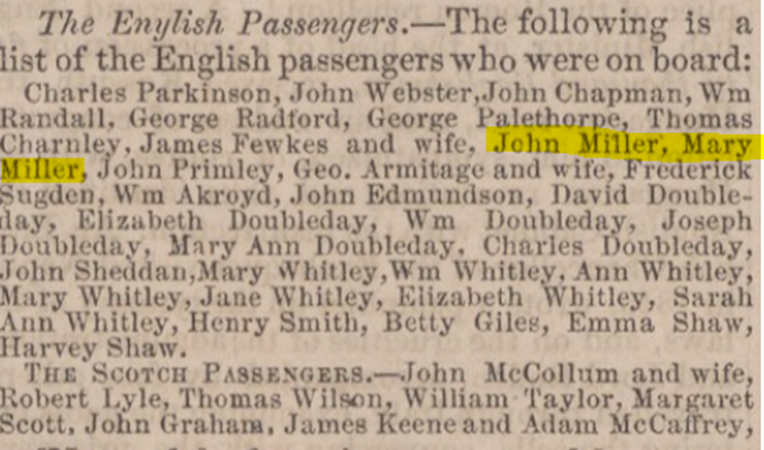
I began my research by trying to confirm that a man named John Miller had sailed aboard the Pomona. The article in the Dublin Evening Mail gives us a first clue – it mentions that in his pocket was proof of payment for passage for himself and his wife to America. After some searching, I found confirmation that there was a man named John Miller aboard the Pomona – in an article in the Boston Pilot on 28th May 1859 entitled ‘Loss of the Ship Pomona’, which was a reprint of an article which appeared in the Wexford Constitution. In addition to giving the details of how the wreck occurred, passenger lists were also provided in this article. In the small list of English passengers – the majority of passengers were Irish emigrants – we find the name of John Miller, and a name for his wife – Mary.

List of English passengers aboard the Pomona, The Boston Pilot, 28th May 1859

In many nineteenth-century shipwrecks, the dead were never identified, their names and stories disappearing with them beneath the sea. That John Miller could be identified at all was due largely to the remarkable survival of the papers found in his pocketbook when his body was recovered at Barry’s Cove. Without these fragile documents, it is likely he would have been buried simply as an unknown victim of a wreck, his connection to the Pomona perhaps lost forever.

Among the most poignant details recovered from John Miller’s body was the discovery of a docket showing payment not only for passage aboard the Pomona from Liverpool to New York, but also for onward travel by railway and steamboat to Hamilton. This small surviving document offers a glimpse into the journey John and wife Mary had planned for themselves. Like many emigrants of the 1850s, they were not simply travelling aimlessly to America, but following an organised route toward a specific destination where work, family connections, or the hope of a more secure future may have awaited them. The fact that arrangements had already been made for the next stage of their journey makes the tragedy all the more heart-breaking. The Millers had not only dreamed of a new life — they were already on the road toward it when the Pomona was lost.

Further tracing the death of John Miller from the Pomona disaster has been difficult because shipwreck records from mid-19th-century Ireland and Britain were often incomplete, inconsistent, or never formally created at all. Although the Pomona sank in 1859 with heavy loss of life, this occurred before the beginning of universal civil death registration in Ireland in 1864, meaning no standard Irish death certificates exist for the victims. Many emigrant passengers were recorded only by name on newspaper casualty lists, while official ‘Deaths at Sea’ registers frequently omitted steerage passengers or failed to survive in full. In cases where bodies later washed ashore, identification depended on local inquests, parish burials, or newspaper reports, many of which are now lost, fragmented, or remain undigitized in local archives. However, we do know from the newspaper excerpts that an inquest was held on the body found in Barry’s Cove, mentioned as having been conducted by Henry Barry Esq. who was indeed the coroner for the east riding of County Cork at that time. We can also confirm from these reports that the recorded verdict was death by drowning as mentioned in the earlier excerpt we have seen from the Dublin Evening Mail.

What was lost in the sinking of the Pomona cannot be measured simply in numbers. Each emigrant on board carried with them the weight of hope — hopes of steady work, of land or security, of families raised far from famine and hardship. They were men and women who had already endured hardship at home and had made the difficult decision to leave Ireland in search of opportunity in America. In another world, some might have become farmers, labourers, craftsmen, shopkeepers, or parents whose children would never know the poverty they themselves had known. Instead, those futures were extinguished on the Blackwater Bank, leaving behind only grief, unanswered questions, and communities forced to mourn lives not yet lived. The wreck of the Pomona robbed not only individuals of their chance at a new beginning, but generations of the contributions they might have made, both in America and in the memories of those who waited in vain for news from across the Atlantic.

There is something especially tragic in the story of John and Mary Miller because, beyond the loss of their lives in the Pomona disaster, so little of their lives now survives in the historical record. We do not know with certainty where they were born in England, what lives they led before leaving home, or what hopes drew them aboard an emigrant ship bound for America in 1859. They may have been seeking opportunity, escape from hardship, or the promise of a better future, but whatever dreams they carried with them were lost in the wreck off the Wexford coast. Even the details of their deaths survive only in fragments, scattered across newspaper reports of the time. Like countless ordinary emigrants of the nineteenth century, they slipped quietly from history, leaving behind little more than their names.

Yet the story that John Miller’s body was carried ashore near Knockadoon and buried in the Hill Cemetery gives our local community a connection to the tragedy of the Pomona. For that reason, it would be fitting to mark the connection with a plaque or memorial, not only in memory of John Miller, but also as a tribute to the hundreds of forgotten emigrants whose lives, ambitions, and futures vanished with the Pomona.

Perhaps this is the true value of local historical research — not merely preserving dates and events, but restoring forgotten people to memory.

References & Further Information

There are numerous online resources available on the Pomona. There is also a ballad written by Patrick Michael Karnahan (The Ballad of the Ship Pomona) and performed by him and the Black Irish Band which commemorates the Pomona, this is available on Spotify & YouTube.

Dublin Evening Mail, Monday 20 June 1859, Page 4, Wreck of the Pomona

The Unfortunate Pomona, The Irishman – Saturday 25th June 1859

Pomona, entry in Wikipedia

The Boston Pilot, Volume 22, Number 22, 28 May 1859Liverpool Daily Post – Wednesday 20 April 1859

From Stormy Seas to the Somme – The Jones Family Memorial in the Hill Cemetery

In the Hill Cemetery in Ballymacoda, there is a gravestone that commemorates Captain William Jones and other Jones family members such as his wife Annie, and his son Lieutenant Hugh M. Jones. The wording on this gravestone says that William Jones ‘perished at sea on March 22nd, 1902’ and also indicates that he was the Master of the S.S. Athena. He was in fact an experienced master mariner with a long career at sea. There is some evidence to suggest that Annie Jones (née Shanahan) was born in Ballymacoda, a daughter of Michael and Mary (née Cleary) Shanahan. This may explain why the Jones plot is in the Hill Cemetery and not in Youghal where the family lived.

William Jones was born in Caernarvonshire, Wales in circa 1844-45. He went to sea as a youth and earned his master’s certificate by the 1870s. He served as a captain in the Liverpool-based Holt Line (which traded as Blue Funnel Line). By 1902, he was 58 years old and had decades of navigation experience, including familiarity with the Cape Horn and Strait of Magellan routes, the routes required to transit between the Pacific and Atlantic oceans at the time.

Portrait of Captain William Jones

The home of William Jones and family in his later years was in Youghal, where the Holt Line had an office and where his family resided while he was at sea. The 1901 Census of Ireland shows Annie Jones and family residing at Friar St. in Youghal. Annie is listed as head of the household, and was very likely managing the family in her husband’s absence, with him away at sea. Born in 1859, four children are listed as being present in the census document: Bertram, aged 14, Hugh, aged 13, Henry, aged 11, and Margaret, aged 9. The household also included a servant, Catherine Keeffe. The family identified as Roman Catholic.

1901 Census of Ireland entry for the Jones Family in Youghal

Like many turn-of-the-century steamers, the S.S. Athena of which Captain William Jones was the master, was engaged in global trade routes. In early 1902, the Athena had been voyaging in the Pacific, and by March she was returning with cargo from Chile back toward the Atlantic. Because the Panama Canal did not yet exist (it would not open until 1914), ships transiting between the Pacific and Atlantic oceans had to brave the far south. One common route was through the Straits of Magellan, a navigable but complex passage through the Chilean Patagonia archipelago. Captain Jones chose this route (as opposed to the even more perilous Cape Horn) for the homeward voyage. This route, while offering some shelter from the open ocean, required threading through narrow channels dotted with islands and hidden rocks in an area often lashed by harsh and unpredictable weather.

On March 22nd, 1902, the Athena was wrecked. The ship encountered severe storm conditions and struck a submerged rock. According to survivor accounts, the Athena foundered in about half an hour after the collision. There was little time to send a distress call or organize a prolonged damage control; the crew had to immediately abandon ship as it became clear the steamer would sink. The wreck had a high loss of life. Approximately 20 of the 31 people on board were killed. Only 11 survivors (all crew members) managed to escape in a lifeboat and were later rescued and brought to Punta Arenas, Chile. The other lifeboat, under Captain Jones, capsized in the heavy seas, drowning all aboard.

Report of the wreck of the Athena, carried in The Savannah Morning News, April 3rd, 1902

After enduring the storm and drifting in the lifeboat, the remaining survivors were eventually sighted and picked up by a vessel. Details of the rescue are sparse in press reports, but it is recorded that 11 survivors from Athena’s crew were “landed at Punta Arenas” (the principal city of the Magallanes region) sometime after the wreck. At Punta Arenas, the survivors would have been received by local authorities and the British consul. It was from there that news of the disaster was telegraphed to the wider world. The survivors were given care after their harrowing ordeal; however, even among those 11 landed, some were in dire condition (it is implied the four who died of exposure passed before or just after the rescue, leaving 11 alive at landing).

Once in Punta Arenas, the men likely gave statements that formed the basis of inquiry into the wreck’s cause. From there the surviving crew eventually made their way home. This remote town in 1902 was a coaling station and hub for ships transiting the Strait, so passage back to Europe or at least to a larger port would be arranged, possibly on another British ship or via steamers to Montevideo or Buenos Aires. The disaster was widely reported in newspapers and maritime records of the time. News dispatches from South America described the wreck’s location and the fate of the crew. Survivor testimonies indicate the wreck was caused by navigational peril in a storm, rather than human error, given the treacherous waters.

Tragically, having gone down with the Athena, Captain Jones would never return to Cork – his body was not recovered. Today this gravestone in the Hill Cemetery in Ballymacoda stands in his memory and in memory to the story of the tragic end of the S.S. Athena.

Probate granted with regard to William Jones, his entire estate going to his widow Annie

Also commemorated on the Jones gravestone in the Hill Cemetery, is the son of Captain William Jones, Lieutenant Hugh M. Jones who was killed in action during the First World War. He was born on July 12th, 1888, and according to the 1901 Census of Ireland records as we have seen earlier, the then 13-year-old Hugh Jones lived at Friar Street in Youghal with his mother and siblings.

At the age of 15, Hugh embarked on a seafaring career, beginning as an apprentice aboard the square-rigged ship Greta in January 1904. His maritime journey continued in July 1905 when he joined the Eagle Brag, eventually achieving the rank of Able Seaman. By 1908, he was serving on the steamer Leno, from April to July of that year. Hugh’s dedication to his maritime profession was further evidenced when he earned his Second Mate’s certificate in Liverpool on October 9th, 1908. At that time, he listed his residence as “c/o Miss Forbes, Carlingford Street, Liverpool”. His official record described him as 5 feet 10 inches tall, with a dark complexion, light brown hair, and grey eyes.

Lieutenant Hugh M. Jones

Tragedy struck the family in March 1911 when Hugh’s mother passed away in Youghal, aged just 54. Her estate, valued at £1,342, was divided between her family. Nonetheless, Hugh’s maritime qualifications continued to progress. He obtained his First Mate’s Certificate in July 1911. In August 1913, he applied for his master’s certificate.

Before the outbreak of the First World War, Hugh was serving with the Holt Line, the same well-known Liverpool-based shipping company that his father had been employed with for many years before his death at sea. However, he soon decided to change course, leaving the sea to pursue a military career. Possibly due to his family’s connection to Liverpool through the Holt Line, he was commissioned as an officer in the 19th Battalion of The King’s Liverpool Regiment.

‘Youghal Man Gets a Commission’, Cork Weekly Examiner, Saturday October 31st, 1914

Hugh’s service in France began in November 1915 in the position of Battalion Signaling Officer. He was killed in action on July 30th, 1916, during the Battle of the Somme. His body was not found and identified after the war; however he is commemorated on the Thiepval Memorial, and on a plague in the Hill Cemetery in Ballymacoda.

Lieutenant Hugh M. Jones’s story is one of quiet determination, professional accomplishment, and ultimate sacrifice. From his early days as a seafarer to his decision to serve his country in a time of great need, his life reflects both the adventurous spirit and deep sense of duty that defined his generation. Though he now lies without a known grave – his name etched on the Thiepval Memorial in France, on the family headstone in the Hill Cemetery in Ballymacoda, and on a WW1 memorial plaque in the same cemetery – serve as poignant reminders of a young life cut short by war.

News of the death of Hugh M Jones, Liverpool Daily Post, Monday August 7th, 1916

There is a final interesting link between the Jones family and Ballymacoda that is worthy of mention. Annie Jones, the daughter of Captain William Jones & Annie Jones, and the sister of Hugh M. Jones married Justin Condon from Youghal. Their daughter, Annie Condon, married William Hennessy, native of Ballymacoda, and the noted ‘candy king’ of Cambridge & Boston in Youghal, on 24th January 1925.

References & Further Information

Historic Graves, CO-THBM-0003, record for the Jones Grave at the Hill Cemetery Ballymacoda

The Savannah Morning News, April 3rd, 1902

1901 Census of Ireland Records

Liverpool Pals Memorial Pages, Entry for Lieutenant Hugh M. Jones

‘Youghal Man Gets a Commission’, Cork Weekly Examiner, Saturday October 31st, 1914

Commonwealth War Graves Commission, Entry for Lieutenant Hugh M. Jones

News of the death of Hugh Jones, Liverpool Daily Post, Monday August 7th, 1916

William Hennessy, the ‘Candy King’ of Cambridge & Boston, Ballymacoda History Project, April 16th, 2021

Shipwrecks Around Ballymacoda #2 – Three Wartime Incidents

In the first article in this series, I discussed probably the most memorable wreck along our coastline, the Tadorna, wrecked off Ballycrenane in 1911. Continuing this series, I’ll delve into some of the lesser known shipwrecks and shipping accidents that have occurred around the Ballymacoda coastline – the first of these are three incidents which occurred during World War I – the running aground of the S.S. Messina in 1917, and the sinking of the schooner Edith and the steamship S.S. Lucena on the same day in 1915 by a German submarine off Knockadoon Head.

The Grounding of the S.S. Messina

The Messina was 4,271-ton cargo ship owned by Gulf Line, based in West Hartlepool, England. The Messina was a relatively new vessel, having been built in 1911 by the Northumberland Shipbuilding Co. Ltd in Newcastle. Towards the later part of World War 1, on the night of February 20th 1917, the Messina ran onto rocks near Knockadoon Head and was stranded. The HM Trawler Indian Empire arrived from Queenstown (Cobh) to assist, under Lieutenant Arthur Sanderson. Three other vessels, the tugs Stormcock, Hellespoint, and Warrior were also involved in the operation. An interesting side note here is that the Warrior had been one of the first vessels to come to the aid of the torpedo stricken Lusitania in May 1915, and was credited with saving 74 lives.

The salvage operation conducted on the Messina off Knockadoon was complex, and lasted three days, with different methods being tried to free the vessel from the rocks. Eventually on February 22nd, Petty Officer J.C. Williams, of H.M. Drifter J.E.C.M., assisted by Sanderson, risking being crushed to death, used explosives to shatter the rocks, which allowed the assembled boats to tow the Messina free.

The tugboat Warrior, involved in the salvage of the Messina off Knockadoon, and also in the Lusitania tragedy

Those involved in the salvaging of the Messina off Knockadoon applied to the British Admiralty for naval salvage money for the successful outcome of the operation. This was common practice at the time, as was the practice of awarding prize bounty money to Royal Navy ships involved in the sinking or capture of enemy vessels. In the resulting compensation case, a sum of £2,550 was awarded to those involved in the salvage of the Messina.

The London Gazette, July 30th 1918 with reference
to the salvage of the Messina

The Messina having been saved from destruction off Knockadoon Head, had difficult times ahead. On the evening of October 15th 1918, on a voyage from Plymouth to Baltimore, it was shelled by the German submarine U-152, in a confrontation lasting 2 hours. The Messina put on full speed and zigzagged in accordance with the wartime regulations, luckily escaping with minimal damage, having been hit once by a German shell on the port side. A little over a year later, on December 14th 1919, having survived the grounding off Knockadoon and the treacherous U-Boat infested waters of World War I, the Messina was abandoned in a storm in the North Atlantic and eventually sank. She was on a voyage from St. John to Antwerp, carrying a cargo of grain.

The final fate of the Messina, two years after she was stranded off Knockadoon, from the Victoria Daily Times, December 1919

The Sinking of the Schooner Edith & S.S. Lucena

The schooner Edith was 78-ton British registered merchant ship, built in 1876, and owned by John Rooney of the port town of Barrow-in-Furness in Cumbria, England. On Sunday June 27th, 1915, she was on route from the town of Silloth on the north coast of England to Cork, carrying a cargo of plaster of Paris. Unfortunately for the Edith, the German U-Boat U-24 under Captain Rudolf Schneider was lurking in the waters about 10 nautical miles off Knockadoon Head.

The crew of the Edith reported that the submarine surfaced 100 yards from them, and was flying the Union Jack flag, a common deception tactic at the time. The submarine crew then ordered them to quickly leave their vessel. The three crew, all men from Kilkeel in Co. Down, got into their punt and began to row a safe distance from the Edith. From their deck gun, the crew of U-24 fired 4 shells and sank the defenseless Edith. The crew of the Edith were picked up and landed in Youghal.

On the very same day, the S.S. Lucena was also stopped in a similar fashion by the crew of U-24 approximately 4 miles south of Capel Island. The Lucena was a cargo ship, operated by Joseph Monks & Co. Ltd. of Liverpool, and was travelling from Granton in Scotland to Bantry with a cargo of coal. Similarly to the Edith, the crew of the Lucena were ordered to leave the ship before it was shelled and sank by U-24. The crew were later picked up and landed in Queenstown (Cobh).

U-24, responsible for the sinking of both the schooner Edith and the steamship Lucena on June 27th 1915 off Knockadoon

In what the U-24 crew probably deemed an extremely successful day, the Indrani, a 3,640 ton steamship was torpedoed by U-24 in St. George’s Channel and also sank on the very same day.

U-24 remained in service for the remainder of the war, until the German surrender in November 1918. The submarine was eventually broken up in 1922.

Report of the sinking of the schooner Edith, carried in newspapers of the time.

With incidents such as these, and the Imperial German navy’s campaign of unrestricted warfare on the seas from 1917, it is very easy to see why the Irish Coast Watching Service was setup in the early stages of World War II. Read more about the coast watching service in Ballymacoda in the previous post on the Ballymacoda History Project – The Coast Watching Service in Ballymacoda – now updated the show the excellent work done recently by members of the local community to restore the ‘LOP 21‘ marking.

References and Further Information

The London Gazette, July 30th 1918

The Victoria Daily Times, Victoria, British Columbia, December 13th 1919

The Sydney Stock & Station Journal, June 30th 1915

Irish Shipwrecks, Entry for ‘Edith’

Wikipedia, List of Shipwrecks in June 1915

The 1856 Fishing Tragedy at Knockadoon

This is the story of possibly the worst fishing related accident to occur in Knockadoon – the loss of five men to the sea in the summer of 1856.

At 6am on Wednesday morning, August 20th 1856, five men and their fishing boat set off from Barry’s Cove for the purpose of hauling their nets (the concrete slipway in Knockadoon didn’t exist at this time). There was a heavy sea and a north-easterly wind blowing. Not a single member of the crew would return alive.

According to newspaper reports at the time, the boat and crew were seen by witnesses on the shore between 7am and 8am that morning, and were in the process of hauling their nets. The sea was rolling and the north-easterly wind was now blowing hard. According to the witnesses, what happened next was to decide the fate of the men – their boat suddenly capsized in the heavy sea.

Three of the men managed to rest on the keel of the upturned boat, and the other two were seen to use the heavy wooden oars of their fishing boat to attempt to support themselves in the water. The men on the keel were seen to call for assistance and attempt to signal to those on the shore that urgent help was needed.

On the shore, the crew of another boat who had just put in, Jeremiah McCarthy, Michael Barry, and John Sheehan attempted to gallantly re-launch their own fishing vessel and reach the men in distress. Ultimately, their brave efforts failed and the men narrowly avoided being drowned themselves in the worsening conditions.

Those on the shore watched helplessly, as their friends and neighbors were lost to the sea. The men on the oars disappeared after a short time, and the men on the keel were eventually beaten off by the terrible conditions. Some time later, their empty boat was driven on to the rocks at Knockadoon and smashed to pieces. It was reported in newspapers of the time that two of the bodies of the men washed ashore that day, but it is unclear when/if the others were recovered from the sea. An inquest was held on the following Friday at Castlemartyr by Henry Barry, coroner for the district, with a verdict of ‘Found drowned‘ being recorded for the men.

The following are the details of the men who drowned, as reported by the Cork Reporter at the time:

William Ahern – aged 47, leaving a wife and three children.

William Barry – aged 45, leaving a wife and five children.

William Lynch – aged 45, leaving a wife and six children.

Garret Barry and Daniel Barry – brothers aged 23 and 20 respectively, reported as leaving an aged mother and father.

Reports of the tragedy at Knockadoon carried widely in both national and international newspapers of the time. Later, an appeal was made to support the families of the deceased fishermen.

Report carried in the Cork Constitution, September 4th 1856

It is a wonder we don’t have some sort of simple memorial to these men at Knockadoon in the form of a plaque or similar. Such a tragic accident should not be lost to the ages.

References and Further Information

Kilkenny Journal, and Leinster Commercial and Literary Advertiser, August 27th 1856

Cork Constitution, September 4th 1856

Shipwrecks Around Ballymacoda #1 – The Tadorna

With the amount of coastline around the Ballymacoda area, it is not surprising that there have been quite a few shipwrecks over the years. In the first article in this series, we’ll be looking at the Tadorna, which was wrecked near Ballycrenane in 1911.

The Tadorna in 1911. From the Horgan brothers collection, the brothers owned a photographic studio in Youghal.

The Tadorna was a 1,643-ton steel hulled cargo steamship owned and operated by the Cork Steamship Co. Ltd. It was built in 1910 by Swan, Hunter & Wigham Richardson at their Low Walker shipyard on the River Tyne, first launched for sea trials on 9th June that year. It was handed off to the Cork Steamship Co. Ltd in August, as reported in The Times of London on 24th August.

Report in The Times of London mentioning delivery of the Tadorna to the Cork Steamship Company by Swan, Hunter & Wigham Richardson

Evidence would suggest that this was the second steamship to be built for Cork Steamship Co. Ltd to be given the name Tadorna, with the original being built in 1896 and remaining in service until 1910, so the new Tadorna looks like a direct replacement for that vessel.

Just over a year after being delivered, in the very early morning of Wednesday 15th November 1911, the Tadorna was approximately 5 miles from Ballycotton, off Ballycrenane. She was on route from Rotterdam to Cork, and was laden with general cargo. On board were Master Henry H. Gregory along with 20 crewmembers. There was a strong South-East gale blowing and very heavy seas. At about 2am, signals of distress were observed from the ship from Ballycotton, and the RNLI lifeboat based there, the T. P. Hearne, was launched with three crew members on board, one being the local priest.

On reaching the Tadorna, the lifeboat crew found it impossible to board due to the darkness and the heavy seas. As the light of dawn approached, the lifeboat crew were able to rescue 9 crew members, making their way with great difficulty in very heavy seas back to Ballycotton. The remainder of the crew were rescued by ‘rocket apparatus‘, a rudimentary but successful life saving apparatus of the time. The operation of the apparatus is described in the Journal of Research on Irish Maritime History:

The apparatus consisted of a tripod rocket launching apparatus, line carrying rockets and a huge quantity of ropes of various thickness. A light line attached to the rocket would be fired to the ship in distress to become entangled in the rigging. The crew would haul a heavy line and a further light line into their ship using this first line. Block and tackle, instructions and a breeches buoy were hauled out to the distressed ship. The victims would be hauled ashore one by one sitting in the breeches buoy, finally a cutting apparatus would be sent out to the ship end of the line to cut away the rope for recovery and reuse.

Description of the usage of the ‘rocket apparatus’ of the type used by the RNLI and coastguard to rescue some of the crew members from the Tadorna.
The Tadorna stranded on the rocks. Original photograph enhanced by John Finn and kindly reproduced with permission

Each of the crewmembers of the RNLI lifeboat from Ballycotton were recognized for their efforts in the rescue of the crew of the Tadorna. The following letter of thanks from the Master of the Tadorna also appeared in the local press a few days later:

Sir,—On behalf of the entire crew of the SS Tadorna, it affords me the greatest pleasure to return our heartfelt thanks for the invaluable and prompt action taken both by the Ballycotton Life-boat crew and the Coastguardsmen with the rocket apparatus, in rescuing us from our perilous position on Wednesday morning last.

The brave and gallant manner in which they rendered these services under most trying conditions is beyond all praise. The officers and myself would also like to thank Mrs. Pomphrett, of Ballycrenane, for the great kindness shown to us, and the hospitable manner in which we were treated by her on our arrival on shore.
Yours truly, Henry H. Gregory, Master

Appreciation letter from the master of the Tadorna

Attempts were made by the Ensor Salvage Company to salvage the Tadorna, which had become stranded on the rocks, but these efforts were unsuccessful and the ship broke in two a few days later.

Remains of the Tadorna today. Photograph credit to John Finn and kindly reproduced with permission

References & Further Information

The Times of London, 24th August 1910

Coastguard Lifesaving Carts, Journal of Research on Irish Maritime History

The Lifeboat, Journal of the Royal National Lifeboat Institution, Volume XXI, Number 244, 1st May 1912