Jeremiah Shea – From Knockadoon to White Court

The more time I have spent delving into the stories of emigrants from Ballymacoda, the more firmly I am convinced that I have only begun to scratch the surface of the most interesting tales. It seems that, despite the passage of generations, only a small fraction of these remarkable stories has ever reached a wider audience, leaving countless individual journeys forgotten. One such journey belongs to an emigrant from Knockadoon, Ballymacoda – Jeremiah Shea – whose path in life took a truly unexpected turn. Far from the familiar coastline of East Cork, he found himself in the orbit of one of America’s most prominent figures, ultimately marrying a woman who was counted among US President Calvin Coolidge’s favourite cooks.

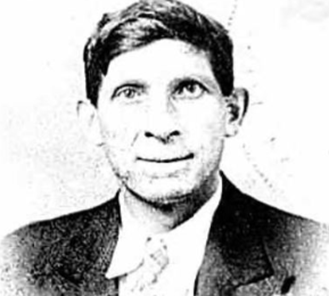
Two pieces of evidence in official United States documentation relating to Jeremiah point to a birth date of July 22nd, 1892. These documents are his World War 2 draft card, and his US naturalization application. Jeremiah’s gravestone also lists his birth year as 1892. Jeremiah’s mother was Norah Shea, and she is listed as a widow in both the 1901 and 1911 Census of Ireland records. Norah lists 8 children, 7 of whom are still living in her 1911 census entry.

There is documentary evidence suggesting that Jeremiah enlisted in the Royal Naval Reserve as a young man and saw active service during the tumultuous years of World War 1, gaining firsthand experience of the global conflict that reshaped the European continent. His Royal Navy medal record indicates that he received the Star (1914 or 1914/15), the Victory Medal, and the British War Medal for his wartime service. After the war ended, like so many others he sought new opportunities beyond the shores of his homeland. In 1920, he made the transatlantic journey that would forever alter the course of his life, departing from Liverpool, and arriving in New York on November 11th. The vessel on which he travelled, the SS Suelco, carried him across the ocean at a moment in history still reverberating with the aftermath of war. Stepping onto American soil in the bustling port of New York marked the beginning of a new chapter, one that would see him integrate into a different culture, forge lasting connections, and lay the foundations of a life far removed from the rural Knockadoon origins of his youth.

Jeremiah worked as a caretaker at the estate of businessman Frank W. Stearns adjoining White Court, seen here on the right. Located on the coast in Swampscott, Massachusetts, White Court became then US President Calvin Coolidge’s ‘Summer White House’ in 1925. He and First Lady Grace Coolidge spent the warmer months of that year there, escaping Washington, D.C.’s summer heat and humidity, while still carrying out official duties. The estate’s name stems from its grand, white, columned façade, and it was one of several locations to which Coolidge would retreat during his presidency to rest and conduct presidential business in a more relaxed setting. It was while working as a caretaker that Jeremiah met his soon to be wife, Margaret Carr during the summer of 1925.
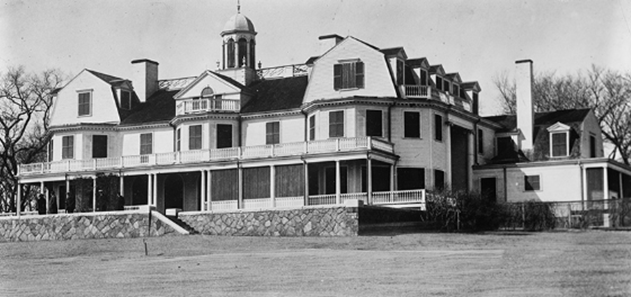
White Court, Swampscott, Massachusetts

Margaret Carr, like Jeremiah Shea, was an Irish immigrant. She had left Galway for the United States in early 1920. Margaret worked as a cook for the Coolidge’s at the White House in Washington, D.C. and was with them in White Court during the summer of 1925. There are references to Margaret being the President’s favourite cook. She had also worked as a cook for previous US President Warren G. Harding before he died in 1923, elevating then Vice President Coolidge to the position of President. Margaret and Jeremiah’s granddaughter recalls from family lore that President Coolidge was particularly fond of Margaret’s corned beef with cabbage, her beef stew and her apple pie. Margaret & Jeremiah were married on October 20th, 1925, at the St Francis de Sales Church, Bunker Hill St. in the Charlestown neighbourhood of Boston. Margaret had resigned from her position as the Coolidge cook shortly before the wedding. The couple honeymooned in Bermuda. After returning they made their home at 58 Main St. Somerville, located directly to the northwest of Boston.

The wedding of these two Irish immigrants in the United States – Jeremiah from Knockadoon and Margaret from Galway – drew widespread attention due to their unique presidential connection and the circumstances under which they first met. In a time long before modern social media platforms and instantaneous news updates, their union nevertheless achieved a level of notoriety akin to the high-profile weddings we might see splashed across the feeds of prominent social media influencers today. Major newspapers like the Boston Globe and the Washington Times carried reports on their nuptials, demonstrating just how fascinated the public was with every detail of their story. After their marriage, the granddaughter of Jeremiah and Margaret recalls that they opened a restaurant aptly called ‘The White Court Lunch’ on Bunker Hill St. in the Charlestown neighbourhood of Boston, where the bestseller on the menu was President Coolidge’s beloved apple pie.

Jeremiah and Margaret had seven children, all born in Massachusetts – Jeremiah Jr (born 1926), Patrick (born 1928), Margaret (born 1929), Delia (born 1931), Timothy (born 1932), Johanna (born 1936) and Daniel (born 1937).

At some point, the family moved to 1 Snow Terrace in Somerville, just a few minutes away from their previous home. The 1940 Somerville city directory confirms the family living at this address, with Jeremiah’s occupation listed as chauffeur. The record of Jeremiah’s petition for US naturalization from November 9th, 1942, also lists his place of residence as 1 Snow Terrace. As mentioned earlier, this record also confirms his birth date of July 22nd, 1892, in Knockadoon. In addition, it confirms that he has never returned to Ireland up to this point.

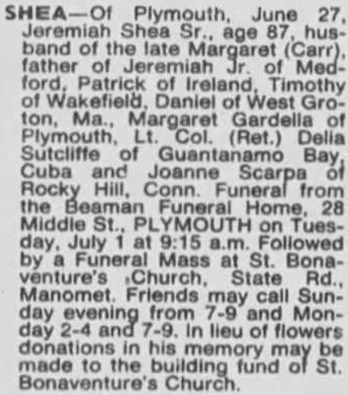
Clipping from The Washington Times, October 22nd, 1925

Jeremiah Shea died in Plymouth, Massachusetts on June 27th, 1980, aged 87. Margaret had predeceased him, having died in August 1977. Both were laid to rest in Vine Hills Cemetery, Plymouth, Plymouth County, Massachusetts.
The story of Jeremiah Shea and Margaret Carr is emblematic of the uncharted chapters in the wider emigrant narrative of Ballymacoda – an extraordinary reflection of how far an individual’s journey can stretch beyond our shores. Their odyssey underscores the resilience and fortitude of countless others whose stories remain hidden in archives or family lore, waiting to be pieced together.

From Jeremiah’s beginnings in Knockadoon and his wartime service, through Margaret’s migration from Galway and subsequent work in two presidential households, their shared trajectory draws a vivid line from Ireland to the heart of American political life. Their marriage and the success they found – whether through their connections to President Coolidge, the bustling restaurant they opened, or the large family they raised – demonstrate that the pathways carved by Irish emigrants often crisscross continents and history alike. In doing so, they remind us that for every familiar tale, there are countless more to discover, each deserving to be chronicled for the role it plays in the ever-evolving tapestry of our diaspora.

References & Further Information

Ireland, Civil Registration Births Index, 1864-1958

1901 & 1911 Census of Ireland

UK, World War I Pension Ledgers and Index Cards, 1914-1923

UK, Naval Medal and Award Rolls, 1793-1972

U.S., World War II Draft Registration Cards, 1942 for Jeremiah O Shea

Wikimedia Commons, Photograph of White Court

The Boston Globe, October 21st, 1925, Page 8, report on the wedding of Jeremiah Shea and Margaret Carr

U.S., City Directories, 1822-1995, Somerville, Massachusetts, City Directory, 1940

The Washington Times, October 22nd, 1925

Kai’s Coolidge Blog, available online – https://kaiology.wordpress.com/2010/09/20/a-coolidge-grace-that-is-dessert-recipe/

Massachusetts, U.S., State and Federal Naturalization Records, 1798-1950 for Jeremiah Shea
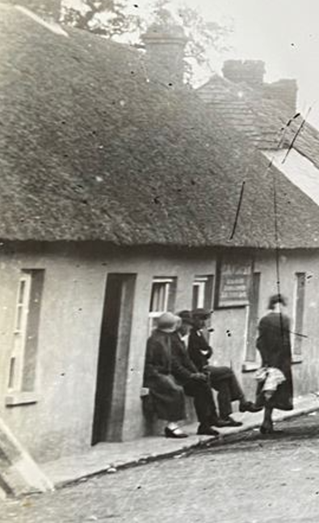
Spirits of the Past: The Historical Pub Trade in Ballymacoda Village

The Public Houses of Ballymacoda have long served as a welcoming haven for both residents and passing travellers, anchoring the social fabric of the area through every season and era. From the moment one crossed the threshold, the comforting glow of the lamplight spilling onto the street on a crisp evening beckoned, drawing people together to share both a freshly poured pint and the warmth of good company. For generations, the gentle hum of conversation, punctuated by raucous bursts of laughter combined with the faint aroma of peat from the fireplace to create an atmosphere that was both convivial and steeped in tradition. Indeed, these were not just places to enjoy a drink; before the age of modern conveniences, they were vital centres of social, economic, and cultural life, where neighbours and travellers alike exchanged news, stories, and customs. The public house likewise served as the gathering place where generations commemorated the passing of loved ones – a tradition that continues to endure today. In this article, we will delve into the historical roots of Ballymacoda’s pub trade, particularly from the mid-19th century onwards.

McLoughlin’s (“Mac’s), early 20th century

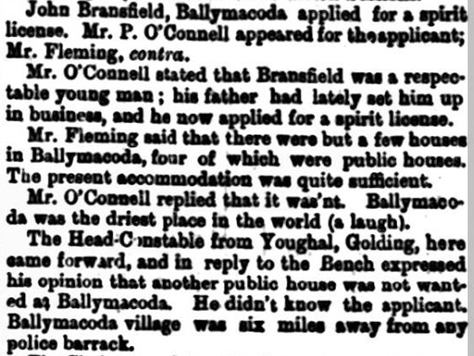
In the Cork Daily Herald on Saturday June 27th, 1868, we learn that John Bransfield has applied for a spirit license in Ballymacoda. Bransfield is described as ‘a respectable young man; his father had lately set him up in business’. There is some evidence to suggest that Bransfield came to Ballymacoda from nearby Midleton, and that he and his wife Margaret raised a large family here (at least 8 children according to the 1901 Census of Ireland records). In this report of his license application, we learn that there are already four public houses in the village, and that the Head R.I.C. Constable from Youghal, Constable Golding, opined that another public house was not wanted in Ballymacoda. It is also mentioned in this report that the nearest police barrack is six miles away, which confirms my previous research on the RIC in Ballymacoda that a barracks did not exist at this time. So, here we have a solid reference that there were four pubs in Ballymacoda in the 1860s. Bransfield’s license application on this occasion was adjourned. Later, in October 1868, the Cork Examiner mentions that the application had been refused.

Cork Daily Herald, Saturday June 27th, 1868

In April 1870, we learn from the Cork Examiner that Maurice Bransfield (likely the father of John) has now applied for a new license in Ballymacoda. Again, it is mentioned in the report of the court sessions that there are already four public houses in Ballymacoda and another is not needed. The application for a new license is once again rejected, with the resident magistrate, Mr. Dennehy, mentioning that ‘if one of the four gave up, the applicant would get a license’. What the magistrate described here would later become law under the Licensing (Ireland) Act, of 1902, a law that is still on the Irish statue book today – and means that no new licenses can be granted, only existing licenses transferred.

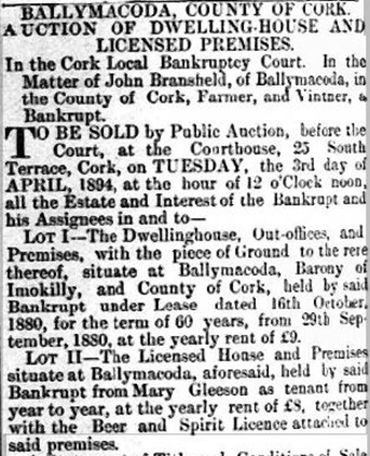
John Bransfield did eventually gain a license transfer – this is captured in the reporting from the Midleton Quarter Sessions in the Cork Constitution on November 1st, 1889. We can gain further insight into this through the many reports from 1893 and 1894 in relation to John Bransfield’s bankruptcy around that time. The notice of the auction of Bransfield’s holdings, which mentions him as a being a Vintner and a Farmer, that appeared in many newspaper reports of his insolvency at the time mentioned that he held a licensed premises from Mary Gleeson year to year for £8. However, the license, as we shall see, was the license from Power’s public house.

Cork Constitution, March 22nd, 1894

In a report of proceedings at the local bankruptcy court carried in the Cork Constitution on November 17th, 1893, we learn that the scenario of Bransfield’s license in Ballymacoda is complex. The license was originally held by Ellen Power, from whom Bransfield purchased it (the records of the Castlemartyr Petty Sessions confirm the existence of Power’s public house in Ballymacoda). However, as part of the license purchase, Mrs. Power was forgiven a sum of money she owed to Thomas S. Coppinger. Coppinger was a well-known and very wealthy merchant from nearby Midleton, and was the local agent of Cork city based brewery Beamish & Crawford. Further under the agreement, dated November 16th, 1888, John Bransfield agreed that he would only deal with Coppinger for porter and ale, and that he would keep his licensed premises in Ballymacoda as a going concern. As part of Bransfield’s bankruptcy, Coppinger was making a claim on the license and his solicitors contended that whoever took over the premises should now be bound to the agreement with Coppinger and only do business with him for porter and ale. The judge in the case, Judge Neligan, reserved judgement, commenting what seemed like his dubiousness ‘that the house must always be used as a public house, and that the covenant should be operative, say, for fifty or a hundred years, long after Bransfield had ceased to exist’. Unfortunately, I have not been able to find further contemporaneous reports that confirm the judge’s final decision, but nonetheless this is very interesting.

The records of the Castlemartyr Petty Sessions are a valuable source of information with regards the public houses of Ballymacoda. These court sessions of the 19th and early 20th century Ireland formed a cornerstone of the local judicial system. These sessions, typically held by justices of the peace (JPs), were central to rural and urban governance, providing a relatively accessible and cost-effective means of maintaining law and order within communities. Several court reports from the records of the Castlemartyr Petty Sessions from the 1870s tell us that the public houses in Ballymacoda at that time were: Power’s, Cotter’s, Gumbleton’s and Walsh’s. There are many examples listing offences relating to public houses in Ballymacoda, which we can use to confirm their existence at specific times. An example of this is the petty sessions held on October 15th, 1886. At these sessions Ellen Power was fined for ‘having her licensed premises at Ballymacoda open for the sale of intoxicating liquor on Sunday the 5th September 1886’. Along with the publican herself, John Donohoe of Gortavadda, William Aher of Ballymacoda, Mary Lynch of Ballymacoda, and Mary Brien of Ballyfleming were fined for being present in Power’s public house on the same day. Interestingly, Ellen Power was fined one shilling for being open and one shilling costs, while the four customers who were present in the pub were given a larger fine of five shillings each and one shilling costs.

Another example of this offence in the records is the aforementioned publican John Bransfield, who was fined twenty shillings for having his premises in Ballymacoda open on Sunday March 23rd, 1890. Bransfield was before the court for the same offence again on December 23rd of the same year, and again in May 1891.

Charges against Publican John Bransfield, Castlemartyr sessions, April 1st, 1890

The Guinness Trade Ledgers (1860-1960) are another good source of information relating to public houses in Ireland. These ledgers were meticulously maintained by Guinness, capturing the essence of their sales and personnel records over a century. Entries were often handwritten during the earlier years, and as the years progressed, the ledger entries were typed. The entries for 1913-1918 which summarize the deliveries to Ballymacoda show three public houses receiving deliveries of Guinness during those years – E. A. McLoughlin, John O’Donoghue, and James Gumbleton. Interestingly there are no orders at all for 1913 in the ledgers, and I can find no records in the ledgers at all before 1914. Were all the pubs ‘Beamish houses’ before then I wonder? As we have seen when discussing John Bransfield earlier, we know that Thomas Coppinger acting as local agent of Beamish and Crawford had exclusivity in at least one pub in Ballymacoda.

In 1924, the ledger entries for Ballymacoda reveal deliveries of Guinness to Gumbleton’s, McLoughlin’s, and O’Donoghue’s pubs. Cotter’s appears from the 1925 ledger onwards which perhaps means that they didn’t stock Guinness before that. The quantities in the ledger entries are listed as ‘Hhds.’, short for ‘Hogshead’, which was a large wooden cask. According to Guinness, the capacity of one Hogshead was approximately 416 pints.

1924 orders of Guinness to public houses in Ballymacoda

To summarize our journey up to this point:

  • In the 1860s and 1870s we know based on newspaper reports of the license aspirations of John Bransfield that there were four public houses in Ballymacoda.
  • Combined with the records of the Castlemartyr Petty Court Sessions, we can ascertain that these were: Power’s, Cotter’s, Gumbleton’s and Walsh’s.
  • In the late 1880s John Bransfield acquired Powers from licensee Ellen Power.
  • The Guinness Trade Ledgers from 1913 tell us that there were deliveries of Guinness to O’Donoghue’s, Gumbleton’s and McLoughlin’s. Cotter’s also existed at this time but may not have stocked Guinness up to 1924 when those entries first appeared in the Guinness Trade Ledgers, or an alternative theory is that Cotter’s was closed and not operating as a public house for a period of time.
O’Donoghue’s, early 20th century

In terms of how the public houses of the 1860s evolved into the 20th and 21st centuries, it progressed as follows:

  • Cotter’s → Finn’s – the Finn family bought Cotter’s around 1984 and then opened it up as Finn’s Tavern in April 1986.
  • Walsh’s → McLoughlin’s → Daly’s – There are no McLoughlin’s living in Ballymacoda in the 1901 census. Edward McLoughlin Snr. came to Ballymacoda as an R.I.C. Constable (he was born in Co. Roscommon) – his entry in the 1911 census, showing him living in Ballymacoda mentions his occupation as ‘retired policeman’. In the same 1911 census data, his wife, Elizabeth McLoughlin’s occupation is listed as ‘publican’. This indicates that sometime between 1901 and 1911 the McLoughlin family bought Walsh’s public house. Dave Daly bought McLoughlin’s in 1990, and it remained open up until around 2010.
  • Power’s → Bransfield’s → O’Donoghue’s – I would posit that O’Donoghue’s may have acquired what was Power’s/Bransfield’s during the bankruptcy of John Bransfield. O’Donoghue’s stopped trading in 2011.
  • Gumbleton’s → Hopkin’s – Gumbleton’s became Hopkin’s and operated until the 1990s.
A Beamish delivery to Cotter’s

All but one public house are now sadly closed – since 2011, Finn’s Tavern has been the only public house in Ballymacoda. From these historical glimpses, it is clear that Ballymacoda’s public houses, which were once as numerous as the lamplights guiding travellers through the village, have evolved considerably over the centuries, transforming in name, ownership, and allegiance to breweries. Yet, through all the changes in licensing laws, economic fortunes, and personal family legacies, one abiding tradition remains: the central role of the pub as a communal gathering place, where residents mark life’s milestones, exchange stories, and nurture the tight bonds that define this close-knit community.

Though only Finn’s Tavern now stands to carry forward these customs, its continued presence in the heart of Ballymacoda ensures that the spirit of warm hospitality, once shared by many public houses, will hopefully endure for generations to come.

Gumbleton’s, early 20th century

References & Further Information

Cork Daily Herald, Saturday June 27th, 1868

1901 & 1911 Census of Ireland Records

Cork Examiner, Tuesday, October 6th, 1868

Cork Constitution, November 1st, 1889, Mention of license transfer to John Bransfield in report of Midleton Quarter Sessions

Cork Constitution, November 17th, 1893, Details on John Bransfield’s Bankruptcy

Cork Constitution, March 22nd, 1894, Details on John Bransfield’s Bankruptcy

Ireland, Petty Session Court Registers, 1818-1919

Ireland, Guinness Trade Ledgers, 1860-1960

Credit to Elizabeth and Gillian Hyde for the photograph of the Beamish delivery to Cotter’s

A Corpse for Sale – The Horror of the Famine

2025 marks 180 years since the onset of the Great Famine (an Gorta Mór), a tragedy that reshaped Ireland’s history and diaspora. The famine had a devastating impact on East Cork, reflecting the broader calamity that swept across Ireland. This catastrophic event was triggered by a potato blight, which decimated the crop that served as a staple food source for a significant portion of the population, estimated at roughly 3 million people in Ireland at that time. The famine led to widespread starvation, malnutrition, and a staggering increase in food prices, profoundly affecting our regions social and economic landscape. As families struggled to survive, the death toll soared, and many were forced to emigrate, resulting in dramatic demographic shifts that altered the community’s fabric forever. While emigration was the solution for some, not everyone had the means to emigrate, especially if that meant to America, where the cost of travelling across the Atlantic was prohibitive for the poorest of the poor people who were most impacted by the famine. While some assisted emigration schemes existed, for example the schemes financed by the Irish Poor Law Boards of Guardians, these schemes were not widespread or consistently available to all who needed them. Some landlords also contributed to the emigration costs of their tenants, but for vastly different reasons. In a few more benevolent cases, landlords genuinely wished to help tenants seek a better life overseas. More commonly, however, landlords viewed it as a cost-effective way to clear overcrowded and unprofitable estates by paying tenants passages to distant lands.

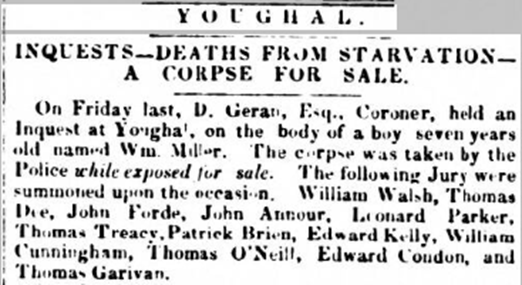
One of the most tragic stories that illustrates what the depths of the famine were like for those in East Cork who faced it, is that of a family from the townland of Ring in Ballymacoda attempting to sell the corpse of a 7-year-old boy, William Miller, in nearby Youghal, who had died from starvation in January 1847. The story of the inquest carried out into the incident appeared in numerous newspapers, including the Cork Examiner, and the details I present in this article are based upon reports from the time. The main people in the story as we shall see are:

  • Daniel Geran – the coroner in the case
  • John D. Ronayne – a chemist with a shop in the town of Youghal
  • Michael Mangan – a sub-constable of the Royal Irish Constabulary (RIC)
  • Richard C. Ronayne M.D. – a doctor in Youghal
  • Thomas & Johanna Miller – those attempting to sell the corpse of the boy

The inquest in Youghal was held on Friday January 29th, 1847. The jury of twelve men that was sworn in were: William Walsh, Thomas Dee, John Forde, John Annour, Leonard Parker, Thomas Treacy, Patrick Brien, Edward Kelly, William Cunningham, Thomas O’Neill, Edward Condon and Thomas Garivan.

Cork Examiner, Wednesday, 3rd February 1847

The first witness to be called was the chemist, John D. Ronayne. He testified that he was in his shop in Youghal on the afternoon of Wednesday January 27th, when a man, identified in court as Thomas Miller, came in and asked him if he wished to buy a corpse. Mr. Ronayne, taken aback, enquired about the gender and age and was told by Miller that the corpse was that of a boy and that he was aged 7 or 8. Ronayne and Miller were interrupted when Ronayne was called to his own house, and when he came back to the shop Miller was gone. However, on inspecting the street, Ronayne saw an RIC man, and alerted him to the situation.

RIC Constable Mangan was sworn in and testified that when another constable was giving him the prisoner Miller after he had been arrested post the encounter in the shop with Mr. Ronayne on the afternoon of January 27th, he observed a woman, identified in court as Johanna Miller, as standing close by. On her back, she carried a basket which was covered with a black cloak. On inspection of the basket, Mangan found the body of a child. At this point, Constable Mangan noted that the prisoner Thomas Miller started to state why he had brought the child for sale and said that the child he had reared for the last six years was ‘an illegitimate child belonging to his sister, and that ‘his mother was in England’.

Next called to the stand, was the doctor Richard C. Ronayne. He testified that he was called upon to examine the body of a young child at the police barrack in Youghal, ‘doubled up in a basket, and covered with straw’. During his examination, the doctor noted ‘not a particle of food to be discovered in the stomach or intestines’, and ‘the total absence of a dispose or fatty matter’. The doctor’s harrowing conclusion was that the boy had died of starvation.

Thomas Miller was next to be called to the stand. Described as ‘a wretched, emaciated looking man’, I am sure he was fairly typical of the time when the poorest of the poor were starving. Miller, of Ring, Ballymacoda, then began his testimony to describe how this heartbreaking event had come about.

Miller, as he testified, had been employed by Mr. Gaggin of Greenland for the last 10 years, and since the onset of the famine, he had been receiving just eight pence a day, which was not enough to sustain his large family of six. He described struggling to feed his family, how his own malnutrition impeded his ability to do physical work, and mentioned having to beg for food from neighbors on occasion. He was forced to go begging to the Relief Committee in Ballymacoda and described how he had been brought by parish curate Rev. Eagar to the house of a woman in Ballymacoda who baked and sold bread and that he had been given two shillings worth of bread. In pure desperation for food, he also described his wife going out to cut Doolamaun (seaweed) and then boiling it with a little salt and eating it. The Miller family were living off this meal of seaweed in the days leading up to the death of the young boy. The references Miller makes here in his testimony to Mr. Gaggin of Greenland makes sense in the context of Ballymacoda. The Gaggin’s held extensive landholdings which they leased in the townland of Ring – much of which was a sublet of land which they had leased from the Marquis of Thomond, one of the main landlords in the area. Griffith’s Valuation of Ireland, completed for Cork in 1853, lists Gaggin’s extensive holdings in the townland of Ring. The newspaper clipping seen here also references the Miller’s home of Ring being ‘opposite Cable Island’, which was common spelling for ‘Capel’ Island at the time, so we can be sure the Millers were from Ballymacoda.

Southern Reporter and Cork Commercial Courier, Tuesday, 2nd February 1847

Thomas Miller’s wife, Johanna, was the last witness to be called at the inquest. Described as ‘a wretched looking poor woman, with a sickly infant at her breast’, she stated that the reason she was selling the corpse was ‘from want’. She recalled going to the landlord Gaggin and begging for a few turnips for her children to eat but being told that the last of them were in the boiler for the horses. Mrs. Miller described stealing some for her family to eat anyway and described how she would have ‘eat the cat from hunger’.

The Jury in the inquest having heard all the evidence ultimately returned a verdict of the boy having died of starvation.

I am certain that none of us today can truly imagine the scenario faced by the Miller family from Ring, Ballymacoda in 1847. They were driven to an insane act by pure desperation for food, and ultimately the desire for survival of themselves and their family. They, like so many others in East Cork and Ireland, had been entirely dependent on the potato to feed their large household and pay the rent. When the blight first arrived, they likely clung to what little savings they had, hoping the scourge would pass. But by the spring of 1847, nothing remained: the potatoes were spoiled, the livestock sold, the rent in arrears, and the children visibly wasting away from hunger.

This was during a dreadful period when the very fabric of rural Ireland seemed to tear at the seams, and a period that is certainly justified by its name of Black ’47.

References & Further Information

“So sad in themselves”: the impact of the Great Famine, RTÉ, available online at https://www.rte.ie/history/post-famine/2020/0909/1164237-so-sad-in-themselves-the-impact-of-the-great-famine/

Irish Potato Famine: A Tragic Chapter in Ireland’s History, History Cooperative, available online at https://historycooperative.org/journal/the-irish-famine/

Southern Reporter and Cork Commercial Courier, Tuesday, 2nd February 1847

Cork Examiner, Wednesday, 3rd February 1847

The Morning Chronicle, Thursday, 4th February 1847, Page 6

Ireland, Griffith’s Valuation, 1847-1864

From Stormy Seas to the Somme – The Jones Family Memorial in the Hill Cemetery

In the Hill Cemetery in Ballymacoda, there is a gravestone that commemorates Captain William Jones and other Jones family members such as his wife Annie, and his son Lieutenant Hugh M. Jones. The wording on this gravestone says that William Jones ‘perished at sea on March 22nd, 1902’ and also indicates that he was the Master of the S.S. Athena. He was in fact an experienced master mariner with a long career at sea. There is some evidence to suggest that Annie Jones (née Shanahan) was born in Ballymacoda, a daughter of Michael and Mary (née Cleary) Shanahan. This may explain why the Jones plot is in the Hill Cemetery and not in Youghal where the family lived.

William Jones was born in Caernarvonshire, Wales in circa 1844-45. He went to sea as a youth and earned his master’s certificate by the 1870s. He served as a captain in the Liverpool-based Holt Line (which traded as Blue Funnel Line). By 1902, he was 58 years old and had decades of navigation experience, including familiarity with the Cape Horn and Strait of Magellan routes, the routes required to transit between the Pacific and Atlantic oceans at the time.

Portrait of Captain William Jones

The home of William Jones and family in his later years was in Youghal, where the Holt Line had an office and where his family resided while he was at sea. The 1901 Census of Ireland shows Annie Jones and family residing at Friar St. in Youghal. Annie is listed as head of the household, and was very likely managing the family in her husband’s absence, with him away at sea. Born in 1859, four children are listed as being present in the census document: Bertram, aged 14, Hugh, aged 13, Henry, aged 11, and Margaret, aged 9. The household also included a servant, Catherine Keeffe. The family identified as Roman Catholic.

1901 Census of Ireland entry for the Jones Family in Youghal

Like many turn-of-the-century steamers, the S.S. Athena of which Captain William Jones was the master, was engaged in global trade routes. In early 1902, the Athena had been voyaging in the Pacific, and by March she was returning with cargo from Chile back toward the Atlantic. Because the Panama Canal did not yet exist (it would not open until 1914), ships transiting between the Pacific and Atlantic oceans had to brave the far south. One common route was through the Straits of Magellan, a navigable but complex passage through the Chilean Patagonia archipelago. Captain Jones chose this route (as opposed to the even more perilous Cape Horn) for the homeward voyage. This route, while offering some shelter from the open ocean, required threading through narrow channels dotted with islands and hidden rocks in an area often lashed by harsh and unpredictable weather.

On March 22nd, 1902, the Athena was wrecked. The ship encountered severe storm conditions and struck a submerged rock. According to survivor accounts, the Athena foundered in about half an hour after the collision. There was little time to send a distress call or organize a prolonged damage control; the crew had to immediately abandon ship as it became clear the steamer would sink. The wreck had a high loss of life. Approximately 20 of the 31 people on board were killed. Only 11 survivors (all crew members) managed to escape in a lifeboat and were later rescued and brought to Punta Arenas, Chile. The other lifeboat, under Captain Jones, capsized in the heavy seas, drowning all aboard.

Report of the wreck of the Athena, carried in The Savannah Morning News, April 3rd, 1902

After enduring the storm and drifting in the lifeboat, the remaining survivors were eventually sighted and picked up by a vessel. Details of the rescue are sparse in press reports, but it is recorded that 11 survivors from Athena’s crew were “landed at Punta Arenas” (the principal city of the Magallanes region) sometime after the wreck. At Punta Arenas, the survivors would have been received by local authorities and the British consul. It was from there that news of the disaster was telegraphed to the wider world. The survivors were given care after their harrowing ordeal; however, even among those 11 landed, some were in dire condition (it is implied the four who died of exposure passed before or just after the rescue, leaving 11 alive at landing).

Once in Punta Arenas, the men likely gave statements that formed the basis of inquiry into the wreck’s cause. From there the surviving crew eventually made their way home. This remote town in 1902 was a coaling station and hub for ships transiting the Strait, so passage back to Europe or at least to a larger port would be arranged, possibly on another British ship or via steamers to Montevideo or Buenos Aires. The disaster was widely reported in newspapers and maritime records of the time. News dispatches from South America described the wreck’s location and the fate of the crew. Survivor testimonies indicate the wreck was caused by navigational peril in a storm, rather than human error, given the treacherous waters.

Tragically, having gone down with the Athena, Captain Jones would never return to Cork – his body was not recovered. Today this gravestone in the Hill Cemetery in Ballymacoda stands in his memory and in memory to the story of the tragic end of the S.S. Athena.

Probate granted with regard to William Jones, his entire estate going to his widow Annie

Also commemorated on the Jones gravestone in the Hill Cemetery, is the son of Captain William Jones, Lieutenant Hugh M. Jones who was killed in action during the First World War. He was born on July 12th, 1888, and according to the 1901 Census of Ireland records as we have seen earlier, the then 13-year-old Hugh Jones lived at Friar Street in Youghal with his mother and siblings.

At the age of 15, Hugh embarked on a seafaring career, beginning as an apprentice aboard the square-rigged ship Greta in January 1904. His maritime journey continued in July 1905 when he joined the Eagle Brag, eventually achieving the rank of Able Seaman. By 1908, he was serving on the steamer Leno, from April to July of that year. Hugh’s dedication to his maritime profession was further evidenced when he earned his Second Mate’s certificate in Liverpool on October 9th, 1908. At that time, he listed his residence as “c/o Miss Forbes, Carlingford Street, Liverpool”. His official record described him as 5 feet 10 inches tall, with a dark complexion, light brown hair, and grey eyes.

Lieutenant Hugh M. Jones

Tragedy struck the family in March 1911 when Hugh’s mother passed away in Youghal, aged just 54. Her estate, valued at £1,342, was divided between her family. Nonetheless, Hugh’s maritime qualifications continued to progress. He obtained his First Mate’s Certificate in July 1911. In August 1913, he applied for his master’s certificate.

Before the outbreak of the First World War, Hugh was serving with the Holt Line, the same well-known Liverpool-based shipping company that his father had been employed with for many years before his death at sea. However, he soon decided to change course, leaving the sea to pursue a military career. Possibly due to his family’s connection to Liverpool through the Holt Line, he was commissioned as an officer in the 19th Battalion of The King’s Liverpool Regiment.

‘Youghal Man Gets a Commission’, Cork Weekly Examiner, Saturday October 31st, 1914

Hugh’s service in France began in November 1915 in the position of Battalion Signaling Officer. He was killed in action on July 30th, 1916, during the Battle of the Somme. His body was not found and identified after the war; however he is commemorated on the Thiepval Memorial, and on a plague in the Hill Cemetery in Ballymacoda.

Lieutenant Hugh M. Jones’s story is one of quiet determination, professional accomplishment, and ultimate sacrifice. From his early days as a seafarer to his decision to serve his country in a time of great need, his life reflects both the adventurous spirit and deep sense of duty that defined his generation. Though he now lies without a known grave – his name etched on the Thiepval Memorial in France, on the family headstone in the Hill Cemetery in Ballymacoda, and on a WW1 memorial plaque in the same cemetery – serve as poignant reminders of a young life cut short by war.

News of the death of Hugh M Jones, Liverpool Daily Post, Monday August 7th, 1916

There is a final interesting link between the Jones family and Ballymacoda that is worthy of mention. Annie Jones, the daughter of Captain William Jones & Annie Jones, and the sister of Hugh M. Jones married Justin Condon from Youghal. Their daughter, Annie Condon, married William Hennessy, native of Ballymacoda, and the noted ‘candy king’ of Cambridge & Boston in Youghal, on 24th January 1925.

References & Further Information

Historic Graves, CO-THBM-0003, record for the Jones Grave at the Hill Cemetery Ballymacoda

The Savannah Morning News, April 3rd, 1902

1901 Census of Ireland Records

Liverpool Pals Memorial Pages, Entry for Lieutenant Hugh M. Jones

‘Youghal Man Gets a Commission’, Cork Weekly Examiner, Saturday October 31st, 1914

Commonwealth War Graves Commission, Entry for Lieutenant Hugh M. Jones

News of the death of Hugh Jones, Liverpool Daily Post, Monday August 7th, 1916

William Hennessy, the ‘Candy King’ of Cambridge & Boston, Ballymacoda History Project, April 16th, 2021

Researching the Ballymacoda Village RIC Barracks

The Royal Irish Constabulary (RIC) was a police force established in Ireland in 1822 to maintain law and order in the country during the period of British rule. In East Cork, RIC barracks were established in towns and villages throughout the region to provide a visible presence of British rule. These barracks were typically located in the center of towns and were often the largest and most imposing building in the area. The RIC barracks dotted around East Cork played a significant role in the region during the War of Independence (1919-1921) and the Civil War (1922-1923). They were often targeted by Irish Republican forces, who saw them as symbols of British oppression. Many RIC barracks were burned or destroyed during this period, as the Irish sought to rid ourselves of occupation.

Ballymacoda, like other towns and villages in the RIC Cork ER (East Riding) area had an RIC barracks for a period, which was located in an area we knew as kids as ‘the barrack‘, located on what is now farmland at the top of the village. However, piecing together the history of the RIC in Ballymacoda has been challenging, and I’m still not convinced I have the fully story. In this article, I’ll outline my research up to now.

The first edition Ordinance Survey of Ireland (OSI) Maps, created by the Royal Engineers between 1829 and 1842, have no mention of a barracks in Ballymacoda village. As these maps listed all major buildings, services etc. it is highly unlikely that a barracks existed in the village at the point at which Ballymacoda was surveyed. However, these maps show the area in which the barrack existed, including the building very likely to be the barrack building itself.

First Edition OSI Map for Ballymacoda. Area in which the RIC barracks existed boxed in red.

The first historical reference to an RIC barracks in Ballymacoda I have found is in fact the announcement of the intention to establish a station at Ballymacoda in November 1841, which carried in the Cork Examiner.

Cork Examiner, November 26th 1841

In 1847 and 1848, the Cork Examiner again provides mention of a barracks in Ballymacoda. But does this provide evidence that it was present at this point, or that the intention still existed for the establishment of a barracks? In both of these years, the same notice is published regarding the intention to place one constable and four sub-constables in Ballymacoda. The language is slightly different to the 1841 notice, in that it doesn’t explicitly mention the establishment of a station, and in fact could be read as a request to augment an existing RIC presence. However, I don’t believe the latter to be the case – I believe at this point there wasn’t a station established in Ballymacoda, but the intention existed.

Cork Examiner, June 7th 1848. The same notice had appeared in 1847.

The next documented reference to the RIC barracks in Ballymacoda is a mention in Griffith’s Valuation of June 1853 for the civil parish of Kilmacdonogh, Barony of Imokilly, which mentions a police barracks present in the ‘Village of Ballymacoda‘. However, I don’t believe this is referring to a barracks in the village – it may be referring to the house occupied by the Lynch’s which was also previously an RIC barracks.

References to Police Barrack in Griffith’s Valuation, 1853

My hypothesis that no barracks existed in Ballymacoda village at this point is backed by the events of the March 1867 Fenian Rising – if a barracks existing in the village, why didn’t the Fenian’s raid that for the arms they sought – they raided the Coastguard Station in Knockadoon instead? A police barracks present in the village at that time would surely have been raided. Researching for some references to prove my hypothesis, I finally found one – an explicit reference to Ballymacoda village not having a police barrack at the time of the 1867 rising, which is some evidence to prove that no station existed up to at least 1867, but as we have seen, the intention to establish a station existed for more than 20 years at this point.

The Morning Post – Saturday 23 March 1867, which references no police barrack existing in Ballymacoda

The 1901 Census of Ireland brings us to our first solid historical reference that proves the existence of the RIC barracks in Ballymacoda. This contains an entry for the inhabitants of the barracks in Ballymacoda. One interesting find here is that the occupants of the barrack on the night of the census seem to have filled out both ‘Form A‘ (the general household return form) and also ‘Form H‘, which was the specialized form intended for military and police barracks. Names on ‘Form H‘ contain first and last name initial only, presumably due to the sensitivity of the information. Since we also have ‘Form A‘ for the Ballymacoda barracks in 1901, we have the information of those that were stationed there in March 1901 when the census was taken, which can be seen below.

Those serving at the RIC barracks in Ballymacoda in 1901

The archives of the ‘Constabulary Gazette‘ also provide some information about the happenings at the RIC barracks in Ballymacoda and provide further proof of its existence. This was the accredited newspaper of the RIC and the Dublin Metropolitan Police, and was published weekly from 1897 to 1922. Amongst other content, it contained general news like crimes committed in specific localities, death notices of former RIC members, and details of station transfers. For example, below we can see Constable transfers between the barracks in Ballymacoda and Killeagh.

Examples of Constable transfers from the ‘Constabulary Gazette’

Perhaps one of the more interesting items found in the ‘Constabulary Gazette‘ relates to an inquiry held in regard to individuals at the Ballymacoda Barracks in 1902, with charges of drunkenness whilst on duty being weighed against a Constable Leahy, and charges of dereliction of duty against a Constable Griffin.

Constabulary Gazette, November 22nd 1902

According to the outcome of the case, published in the November 29th 1902 issue of the Gazette, Constable Leahy was fined £1 10s, and Constable Griffin was dismissed from the force. In a subsequent update on the story, published in the Gazette in December 1902, Constable Griffin later emigrated to South Africa.

Constabulary Gazette, December 20th 1902

So when did the RIC barracks in Ballymacoda cease to exist?

There is some conflicting evidence here. Numerous newspapers (including the Cork Examiner) carried the below report of the station being closed in the summer of 1909. This also referenced the station was closing after ‘a period of twelve years‘, which would indicate that it opened in 1897.

News of the Ballymacoda barrack closure, May 1909

The 1911 Census of Ireland contains no entries for a barrack in Ballymacoda, as it did in 1901 as we have seen earlier. This would seem to indicate solid evidence that the barrack was closed by 1911, and indeed may have closed in 1909 as reported by the Cork Examiner and others.

One puzzling piece of evidence that conflicts with this, is that the last edition of the historic Ordinance Survey of Ireland (OSI) maps, as with earlier maps, show the location of the police barracks in the village – however since this is referenced as a Garda station, this would have to have been after 1923. After the Civil War and the July 1921 truce, the RIC was disbanded, and a new police force was established, initially called ‘The Civic Guard‘ before being renamed Garda Síochána na hÉireann on August 8, 1923. This may be an error, for example an assumption being made that a barracks still existed at this site based on earlier maps.

Last Edition of the Historic OSI Maps referencing a Garda Station in Ballymacoda

Another conflicting piece of evidence, is that much later, in 1932, there is a mention in a Dáil Éireann debate on Wednesday, 20th April 1932 by Cork South East Fine Gael TD, Brooke W. Brasier, of “…a number of reductions in Civic Guard barracks. A barrack at Ballymacoda has been done away with, and I believe a number of other reductions have been carried out by the ex-Minister for Justice.” One would clearly assume that the closure was recent to this statement being made in the Dáil, or this statement may have been made in error, there is no way to tell.

There is evidence that the reestablishment of a police barracks in Ballymacoda was desired. In the financial accounts of the Irish Department of Justice, there are references in the 1928-29 and 1931-32 accounts of this, with clear evidence of funding being sought for a new barracks in Ballymacoda (by then a barracks for An Garda Síochána). Both entries carry the note, ‘Work Postponed‘ with no funding allocated.

Budget allocation for new barracks in Ballymacoda in the 1931-32 accounts of the Department of Justice

Piecing together the history of the RIC barracks in Ballymacoda has proven challenging. From newspaper reports and official documents, we know that a barracks was desired in Ballymacoda as early as 1841. It seems likely that the barracks was not yet established by 1867; otherwise, it might have been targeted during the Fenian uprising. However, records confirm its existence in 1901, as shown in the 1901 Census of Ireland. Additional evidence appears in the RIC’s official publication, the Constabulary Gazette. Reports from the time suggest the barracks closed in 1909. While multiple sources confirm its presence, the precise timeline of its operation remains unclear.

References & Further Information

Ordnance Survey; First Edition; Six Inch to One Mile (1:10,560); County Cork, Sheet 78; Ballymacoda: Surveyed by Major Waters and Lieutenant Stace, Royal Engineers, under the direction of Thomas Larcom, Virtual Record Treasury of Ireland

Records of the Cork Examiner

Sir Richard Griffith’s Three Valuations of Ireland 1826-1864

National Archives of Ireland, Census of Ireland Records for 1901 and 1911

Archives of the Constabulary Gazette (1897-1922), National Library of Ireland

British Newspaper Archive

Dáil Éireann debate – Wednesday, 20 Apr 1932 Vol. 41 No. 3

Compensation Claims after the War of Independence and Civil War 

The Damage to Property (Compensation) Act 1923 was passed by the Oireachtas on May 12th of that year. The goal of this legislation was to facilitate claims for damages to personal property that occurred after July 11th 1921 – the date of the Truce between the Irish Republican Army and the forces of the crown, and up to March 20th 1923 – covering the period of the Irish Civil War also. In 1933, the act was amended to allow for claims for the period April 24th 1916 – May 12th 1923.

Ballymacoda and its surrounds were not exempt from damages during the war of independence and civil war, and I have been researching the records available in the National Archives of Ireland to examine what post truce claims were made by people from the Ballymacoda area. The records offer us a perspective on how the struggles affected the community, underscoring the real impacts on ordinary individuals. The claims that are recorded range from damage to property to the theft of clothing. The claims were administered by the County Court. For each claim, the name and address of the claimant was listed, along with details of the claim, the location of the incident, the date it occurred, and if possible the perpetrators were identified.

Below are the claims in the records for the Ballymacoda area. Interestingly, the events of three are listed as having occurred on the same date – January 30th 1923. On the this date, McLoughlin’s public house in the village was raided, clothes were stolen from a Mrs. Rumley, and Shanahan’s shop was raided for tobacco.

All claims that follow here are listed verbatim as they appear in the available records in the National Archives.

Norah K Neville O’Brien, Aghavine House, Ballymacoda, County Cork

Seizure and destruction of bicycle at Aghavine, County Cork, by unknown persons on 13 September 1920; damage to wall and destruction of trees at Aghavine, County Cork, on 6 November 1920; seizure of property, damage to wall and destruction of trees at Aghavine, County Cork, on 16 April 1921; damage to car and seizure of horse and trap at Aghavine, County Cork, by unknown persons on 24 June 1921; destruction of trees at Aghavine, County Cork, on 15 July 1921; damage to applicant’s land at Aghavine, County Cork, due to traffic between April 1921 and July 1921.

Elizabeth A McLoughlin, Ballymacoda, County Cork.

Raiding of public house and seizure of money by unidentified armed men on 30 January 1923.

Margaret Rumley, Ballymacoda, County Cork.

Seizure of clothes by unidentified armed men who said they were acting on behalf of Irregular forces on 30 January 1923.

John O’Donoghue, shopkeeper, Ballymacoda, County Cork.

Goods and provisions, including meals, liquor and 1 overcoat, seized at same address by the IRA between August 1921-April 1923.

Ellen Cashman, Ballymacoda, County Cork.

Provisions, including coal, tea, butter and drapery goods, seized at same address by the IRA in August 1922 and January 1923.

John Motherway, Ballycrenane, Ballymacoda, County Cork.

One bicycle seized at same address by the IRA in June 1921.

Mary Teresa Shanahan, shopkeeper, Ballymacoda, County Cork.

One side of bacon, cash and 2 buckets supplied at same address to the IRA in August 1922; premises raided and quantities of tobacco seized by the IRA on 30 January 1923.

George Glennon, Curraheen, Ballymacoda, County Cork.

One bicycle commandeered at Corralea, County Roscommon by armed men on 6 June 1922.

Michael Connery, Glenawilling, Ballymacoda, County Cork

Four tons of hay and 6 tons of straw burned and destroyed at Glenawilling, County Cork, by unknown persons on 17 March 1923.

William Wigmore, Ballydaniel, Ballymacoda, County Cork.

Destruction by fire of hay stocks by unknown persons on 14 July 1921.

Mary Linehan, Ardnahinch Post Office, Garryvoe, County Cork.

Damage to property and cattle driven from land at Ballydaniel, Ballymacoda, County Cork, by unknown persons from 25 November 1922 to 30 November 1922.

References & Further Information

National Archives of Ireland

A Short History of Knockadoon Camp

Knockadoon Camp’s origins trace back to Béal Átha an Ghaorthaidh (Ballingeary), located on the opposite side of County Cork. It was there, in 1922, that Father Stephen Glendon, a Dominican from St Mary’s Dominican Priory in Cork City, initiated an Irish language summer camp exclusively for young men and boys. The camp operated in its original location for two years before relocating to Knockadoon in 1924. The decision to move was influenced by the camp’s desire to be closer to the sea. Being situated near the coast provided opportunities for various water-based activities and added to the overall appeal of the camp experience.

Boys from Christian Brothers College Cork attending Knockadoon in July 1960

The camp in its original form was an adjunct to a confraternity for young men and boys in their late teens called the Angelic Warfare Sodality (a sodality essentially being a group of people who promise to pursue some good together within the Church). Fr. Stephen Glendon O.P. was the founder and first Director of the camp at Knockadoon. He was born Henry Stephen Glendon in Dundalk, Co. Louth, on May 13th 1866. He entered the Dominican order at Tallaght in 1887, and was ordained in Rome in 1892. After spending a few years in Lisbon, he arrived back in Dublin in 1894 and ministered at St. Saviour’s Church. He left Dublin in 1907, and served in Galway, Sligo and Tralee before being placed in Cork.


Advertisement for Knockadoon Camp appearing in ‘An tÓglach’ in July 1925 (magazine of the Irish Defense Forces)

The original camp was setup to cater for young men and boys aged 12 years and over. The aim was to give attendees the experience of the outdoors and being close to nature. Attendees at the camp were asked to bring towels, a bathing costume, and soap. Hurls were allowed if the attendees wanted to bring them, as were musical instruments, and bicycles for which a store was available. The cost per person was 3s per day, and the minimum stay at the camp was 1 week. Through an arrangement between the camp and Great Southern Railways and Great Northern Railways, special concessions were available on tickets for campers, on issue of a voucher signed by the Director of the Camp. The nearest railway station was Killeagh, and each Saturday a charabanc (a horse-drawn, early form of a bus) would meet the train in Killeagh to collect campers, for which they were charged one shilling.

An early group of campers at Knockadoon, from the archive of Vincent Travers

As you would expect of a Dominican run camp, promotion of the Catholic ethos was a key aim, and campers were expected to attend mass each morning at 08.30am in the oratory of the camp, as well as participating in the saying of the Holy Rosary daily. Confession was also available to campers.

An open day at the camp in 1930

Campers were given three meals a day in the dining hall, and porridge and milk was available to everyone each night before the regular Cèilidh. It is interesting to note that food wasn’t restricted at the camp – anyone wishing to have more than usually allocated, was allowed. At this time, all the campers slept in tents, each in their own bed. In bad weather, the campers slept in a large dormitory. There were also a limited number of timber bungalows used for sleeping.

The camp in July 1960, the tents used as dormitories are clearly visible here

Sanitary Arrangements‘ at the camp were described as ‘perfect‘ in camp literature. With the latrines ‘erected in a secluded corner on the edge of a cliff‘ and ‘flushed by the tide‘. Not surprising for the time, but this setup wouldn’t be described as ‘perfect‘ today!

Original timber bungalows at the camp, these were used up to 1986 when they were replaced with concrete structures

Upon its relocation from Béal Átha an Ghaorthaidh to Knockadoon, the camp underwent changes in its language program. The previously compulsory Irish language classes were eliminated, and instead, campers were encouraged to engage in conversation using the Irish language as much as possible during their time at the camp. Despite the removal of mandatory classes, fostering Irish culture and language continued to be a significant objective. Each night, a Cèilidh was held in the camp hall, or if weather permitted, an open-air Chuirm Cheoil around the camp fire. Attendees at the camp were also given the option to learn traditional Irish singing.

The main activities at the camp at this time were swimming, boating, hurling and football games, and picnics and excursions to local areas of interest such as Capel Island (with the help of local fishermen). While the aim of the camp was to provide a relaxed atmosphere, discipline was maintained, with early camp literature mentioning that ‘the right is reserved to send home any boy whose influence is deemed harmful‘.

Thousands of boys from all over Ireland attended the camp in the 1920s after its founding – over 400 in 1928 alone. The camp in the 1920s was also used by the Dominican Order for other purposes. Notably, William Shakespeare’s The Merchant of Venice was staged at the camp in the summer of 1926.

Announcement of the staging of The Merchant of Venice at Knockadoon, this carried in the Cork Examiner, July 29th, 1926

Knockadoon Camp in its initial existence continued to flourish until 1933, when the driving force, Fr. Glendon, was transferred to Galway. Between the end of the 1933 season and 1955, only small groups used the camp. With World War 2 also occurring during this period, the camp was fully closed due to rationing of goods during ‘the emergency‘ as it was called in Ireland, and also the risk of the camp being mistaken for a military post.

Headline from Cork Examiner article announcing the full reopening of the camp, Friday June 17th, 1955

In the 1980s, some investment at the camp saw the building of concrete structures to replace the existing timber bungalows.

Building of new accommodation in progress in 1985

The ‘New Hall‘ was also constructed in 2006, adding more space for activities, and 2023 is seeing refurbishments of the bunkhouses take place.

New buildings completed in 1986. The building in the foreground, one of the original timber bungalows, was known as ‘Little House on the Prairie’ and was left intact to be used as an art room

Today, Knockadoon Camp is used for multiple different camps throughout the summer season, and offers a diverse range of activities and programs for campers, including sports, arts and crafts, drama, music, dance, and outdoor adventures. The camp relies on a dedicated team of volunteers who contribute their time and efforts to make it a success. These volunteers, often former campers themselves, play a vital role in organizing activities, providing guidance, and creating a positive and inclusive atmosphere.

Coláiste Cúram, established in 1975, is a three-week program that has been nurturing a deep appreciation for the Irish language and culture among young people. It has remained an integral part of the camp’s annual summer schedule ever since, except for the years 2020 and 2021 when the camp had to be closed due to the Covid-19 pandemic.

Knockadoon Youth Week (KYW) is another staple of the summer schedule at the camp. This has run since 2011, and now runs over four separate weeks each summer and has 100s of volunteer leaders from all over Ireland, many of them previous attendees of the camp.

Camp Creideamh, established in 2016, is a catholic faith camp for boys and girls which runs for one week in June each year.

Knockadoon Music & Liturgy Course has also been a regular part of the summer in Knockadoon for 40 years. This is a one week residential course for young people involved in church music.

Since 1999, the camp has also been used by the Society of Saint Vincent de Paul during the summer to host groups of children.

Over the years, Knockadoon Camp has evolved into a cherished institution, offering young people the chance to immerse themselves in Irish culture, language, and various recreational activities. The camp has had a significant impact on the local community and beyond. It has served as a place for young people to connect, learn, and grow, fostering lifelong friendships and memories. Many campers return year after year, and some become volunteers or leaders, further contributing to the camp’s legacy.

Overall, Knockadoon Camp has a storied history of promoting Irish culture, faith, language, and personal development. Its inclusive and engaging environment has ensured that attendance remains a lifelong memory for the generations of young people from across Ireland who have attended over the years. We are lucky to have it in our locality.

References & Further Information

A special word of thanks to Billy Harrington, who provided many of the photographs and newspaper clippings used in this article

Knockadoon Camp Website

Coláiste Cúram Website

Knockadoon Music & Liturgy Course

Knockadoon Youth Week

Jerry Aher: A Fenian’s Story

Previously writing on the Ballymacoda History Project, I have covered the 1867 Fenian rising and the involvement of Ballymacoda men Peter O’Neill Crowley and Thomas ‘Bowler’ Cullinane. In this post I’ll delve into the story of another contemporary of O’Neill and Cullinane – Jeremiah (Jerry) Aher – who as well as being involved in the raid on the Coastguard station during the rebellion, was also later associated with one of the most famous Fenian prison breaks of the time – the Catalpa rescue.

Photograph of Jerry Aher, taken after his deportation to Australia

Some records list Jeremiah Aher as being born in Ballymacoda in 1841, but he was more than likely born in 1844. This is corroborated by:

  1. Parish records – there is a Jeremiah Aher listed as being baptized on September 4th 1844.
  2. The 1867 Irish prison register – Jeremiah Aher is listed as being 23 years old in 1867, at the time of his arrest for participation in the Fenian rising.
  3. The 1882 California voter register (where, as we will see later, Jeremiah lived for many years), lists his age as 38, again pointing to a birth year of 1844.

Jeremiah was the son of William Aher and Mary Crowley, and it was through his mother that he was a cousin of the aforementioned Peter O’Neill Crowley, who led the rising locally in 1867. Jeremiah had four brothers – John, Timothy, Thomas and William, and two sisters – Johanna and Mary.

The raid on the coastguard station at Knockadoon took place on the night of the Fenian rising – Tuesday March 5th, 1867. The raid, in which Aher, Cullinane and others were involved was led by O’Neill Crowley and John McClure, an American born veteran of the Civil War. The primary goal of the operation was to secure arms, and it was successful, with John Devoy calling it “the neatest job done by the Fenians in the Rising“. While the raid in Ballymacoda was successful, the rising nationally was ultimately a failure and as we have seen previously O’Neill Crowley met his fate at Kilclooney Wood on the morning of Sunday March 31st, three weeks after the rising.

Jerry Aher was tried along with the other captured Fenian rebels in Cork and was convicted of treason on May 2nd 1867. He was sentenced to 7 years penal servitude. While they were awaiting trial, Aher and many other Fenian prisoners were held in Mountjoy jail in Dublin.

Reports of the sentencing of some of the Fenian prisoners, including Jerry Aher, which carried in English newspapers after the rebellion.

He and his fellow convicts were deported first to England, to be held in the infamous Millbank prison in London (now the site of the Tate Britain gallery), which was used as a holding area for those awaiting deportation to Australia. Aher and the other prisoners were held at Millbank until October 1867. His prisoner record from Millbank actually lists him as being removed from there on September 30th, and also records a visit from his father. After Millbank, they were to be deported to Western Australia aboard the prison ship Hougoumont.

The voyage of the Hougoumont lasted 89 days, with the vessel arriving in Western Australia on January 10th 1868, and was of particular historical significance in that it was the last convict ship to carry Irish prisoners to Australia. David Joyce (from the Garryvoe area) and Edward Kelly were aboard the same ship, as well as Thomas ‘Bowler’ Cullinane. The Fenian prisoners, 62 of the 289 convicts that arrived aboard Hougoumont, were taken to Fremantle Prison, and Jerry Aher became convict number 9645. Conditions for the men in Fremantle Prison were very poor. When not completing back-breaking labor, or seconded to work parties assigned to the hard labor of road building in searing temperatures around Fremantle, the Fenian prisoners were confined to their small cells. Before the rising and his arrest, Jerry Aher had been a carpenter and his skills were put to use in the colony.

From the Perth Gazette and West Australian Times, announcing the arrival of the Hougoumont, January 17th 1868

Aher’s prison record lists multiple disciplinary actions during his stay in Fremantle, all occurring in February and March 1869. On February 3rd 1869 he was sentenced to 7 days bread and water for ‘mutinous conduct‘. He was sentenced to the same punishment again on February 19th and March 6th for ‘refusal to work‘. On March 20th, he was sentenced to ‘indefinite solitary confinement‘, again for ‘refusal to work‘. It is not clear how long he remained in solitary.

In early May 1869, Aher and other Fenian prisoners were granted an official pardon, signed by the British Home Secretary, Henry Austin Bruce. This was largely due to the sustained campaign for a Fenian amnesty at home in Ireland. Records show that Jerry Aher received a free pardon on May 15th.

While some of the Fenian prisoners left immediately, for example as in the case of Thomas ‘Bowler’ Cullinane who left for Sydney soon after their pardon, Jerry Aher stayed on in the Perth/Fremantle area. In 1873, he met and married Mary Ann Brennan, herself an Irish emigrant. Their first son, William Joseph Aher was born in July 1874. In the next phase of Jerry Aher’s life, he would participate in one of the most daring Fenian prison breaks of the time, the Catalpa rescue.

With the Fenian pardons issued in 1869, and another round in 1871, only a small number of Fenian prisoners – those deemed most militant by the British – remained in captivity. One of those was James McNally (also known by his alias James Wilson), a Fenian from Newry, Co. Down. McNally had a letter smuggled out of the prison and sent to John Devoy in America. Devoy, an ardent Fenian, had himself been granted amnesty in England in 1871 on the condition that he emigrate to America and never return.

Dear Friend, remember this is a voice from the tomb. For is not this a living tomb? In the tomb it is only a man’s body that is good for worms, but in the living tomb the canker worm of care enters the very soul. Think that we have been nearly nine years in this living tomb since our first arrest and that it is impossible for mind or body to withstand the continual strain that is upon them. One or the other must give way. It is in this sad strait that I now, in the name of my comrades and myself, ask you to aid us in the manner pointed out… We ask you to aid us with your tongue and pen, with your brain and intellect, with your ability and influence, and God will bless your efforts, and we will repay you with all the gratitude of our natures… our faith in you is unbound. We think if you forsake us, then we are friendless indeed.

Letter from James McNally to John Devoy, which prompted the Catalpa Rescue

Devoy consulted with other exiled Fenians in America – John Boyle O’Reilly, himself an escapee of the same prison colony in Australia which held the remaining Fenian prisoners, and Thomas McCarthy Fennell, a Fenian who had left the colony after being pardoned in the 1871 amnesty. All were members of Clan na Gael. It was Fennel who suggested that a ship be purchased and sailed to Australia to rescue the remaining imprisoned Fenians. The rescue was funded by Clan na Gael. What they purchased was the Catalpa, a three-masted merchant bark, 90 foot long, and the ship sailed for Australia from New Bedford, Massachusetts on April 19th, 1875, as a legitimate whaling expedition, under Captain George S. Anthony. Most of the crew were unaware of the real intent of the voyage. In parallel with the sailing of the Catalpa, Devoy had enlisted two Fenian agents to travel to Western Australia – John Breslin and Thomas Desmond – to begin preparations in advance of the arrival.

Illustration of the Catalpa and the Fenian prisoner escapees

Jerry Aher had secured work as a carpenter, and encountered Desmond who told him of his mission in Western Australia – that is how he became involved in the Catalpa rescue. While there is no information available on exactly how Jerry Aher contributed, his local knowledge and contacts were no doubt invaluable to the Fenian agents and the overall escape plan. On March 29th, 1876 the Catalpa berthed at Bunbury, Western Australia, and Captain Anthony along with Breslin and Desmond, who had met the ship on arrival, sailed for Fremantle on board the steamer Georgette. The plan was to secure escape of the remaining Fenian prisoners while they were part of a work party, and this was executed successfully. Having been pursued for a time by the authorities, the Fenian prisoners and the Catalpa eventually escaped, and the men were finally free. The Catalpa sailed triumphantly into New York in August 1876, carrying the escaped Fenian prisoners.

In May 1876, passenger records show that Jerry Aher sailed for Melbourne with his wife and child onboard the Northern Light. Later that year he travelled to San Francisco, California, where he settled permanently. This is corroborated by multiple items if historical evidence. The 1880 United States Federal Census shows Jerry Aher living at 38 Larkin Street, in San Francisco. His occupation is given as ‘House Carpenter‘, which indicates he once again fell back on his pre-rising/incarceration occupation. The 1882 Voter Register for California, shows that he became a naturalized US citizen on February 27th, 1882. Twenty years later, the 1900 United States Federal Census shows the Aher family living at 1411 Bush Street in San Francisco, and at 158 20th Avenue in the 1910 Census.

I have found no records to indicate that Jerry Aher ever returned to Ballymacoda.

Jeremiah Aher in later life, pictured with his wife and three sons

Jerry Aher died in California on January 29th 1926, having lived an extraordinary life. He was buried in Holy Cross Catholic Cemetery in Colma, San Mateo County. Mary Ann died on December 28th 1930.

The grave of Jerry Aher, in Holy Cross Catholic Cemetery in Colma, San Mateo in California. Unfortunately the gravestone is in a state of disrepair today.

References & Further Information

Amos, K., The Fenians in Australia, 1865-1880, Sydney, 1988

Australian Convict Transportation Registers – Other Fleets & Ships, 1791-1868

Ballymacoda & Ladysbridge Parish Records, Entry for baptismal of Jeremiah Aher, September 4th, 1844

Ireland, Prison Registers, 1790-1924

Millbank Prison Record for Jeremiah Aher – UK, Prison Commission Records, 1770-1951

Fremantle Prison Convict Database

Australia, Marriage Index, 1788-1950

The San Francisco Examiner, San Francisco, California, Tuesday, December 30, 1930 (Obituary for Mary Ann Aher)

1880 United States Federal Census

California, U.S., Voter Registers, 1866-1898

1900 United States Federal Census

1910 United States Federal Census

Biography of Jeremiah Aher, State Library of Western Australia, JS Battye Library of West Australian History Collection

The Dungarvan Observer, April 17th, 1926 (republished obituary of Jeremiah Aher under the heading of ‘Death of Old Fenian in San Francisco’)

Timothy A. Smiddy – the Ballymacoda Connection to Ireland’s First Ambassador

Evident from my research for the Ballymacoda History Project is the fact that people from Ballymacoda have made their mark on the world. We have successful and noted businesspeople, clergymen, academics, poets and patriots that we can claim as our own. Very often I come across surprising links also, and this is the story of one of those – Timothy Aloysius Smiddy, a contemporary of Michael Collins, and the first man to be appointed ambassador to another country by the Irish Free State.

Timothy A. Smiddy

Timothy A. Smiddy was born in Kilbarry, a small townland on the northside of Cork City, near Blackpool. He was born on April 30th, 1875, and was the son of William and Honora (nee O’Mahony) Smiddy. His father William Smiddy is what gives us our link the Ballymacoda – William was born in Ballycrenane, Ballymacoda on May 9th 1848, as were his parents (Timothy’s grandparents) – Timothy Smiddy (1793-1873) and Mary Boozan (Beausang – a distant relative of my own) (1806-1883).

William Smiddy, father of Timothy Smiddy, born in Ballycrenane, Ballymacoda in May 1848

By the time of Timothy’s birth in 1875, his father William had built up a successful merchant business in Cork city and ran a victualler business on Grand Parade, thus allowing Timothy the benefit of receiving a fine education. He attended St Finbarr’s College (Farranferris) on the northside of Cork City, and later, with his contemplation of becoming a priest, studied in Paris for a number of years, before moving to Cologne, Germany, to study commerce and economics.

Kilbarry House, the Smiddy family home in Cork

Returning home to Cork, Timothy married Lilian (Lily) O’Connell at St Finbarr’s Cathedral in October 1900. He went on to study at University College Cork (then Queen’s College Cork), and graduated with a B.A. (1905) and an M.A. (1907). He became staff at the University in 1909, accepting a position to teach in the Faculty of Economics, later becoming Dean of Faculty and Professor of Economics. Timothy and Lily had six children, and the 1901 and 1911 Census of Ireland records show them living in Cobh. It is interesting the see the evolution of Timothy’s listed profession on the Census forms. It was listed as ‘Timber merchant‘ in 1901, which he worked as while studying, and listed as ‘Professor of Economics and Commerce B.A.,M.A‘ in 1911.

Obviously, the most notable event from an Irish perspective at the time period we are discussing was Ireland’s ongoing struggle for independence. In 1921, following the War of Independence and the resulting truce, Timothy Smiddy was appointed by fellow Cork-man and friend Michael Collins to be his Economic Adviser to Plenipotentiaries for the treaty negotiations that were to happen in London between October and December of that year. Smiddy was one of four economic advisors appointed to the Irish delegation. At the time, Collins’ official role in the government of the proclaimed Irish Republic was Minister for Finance.

In 1922, Smiddy was called upon again by Collins and sent to the United States to be the Irish Free State’s financial representative in Washington. His role was officially recognized in 1924, and he served as Minister Plenipotentiary and Envoy Extraordinary to the United States of America for the Irish Free State until 1929. During this time he facilitated the visit of William T. Cosgrave to the United States in 1928, the first leader of the Irish Free State, accompanied by Desmond Fitzgerald, Minister for Defence.

WT Cosgrave arrives in Washington DC, Timothy Smiddy, who flanked Cosgrave for much of his visit, can be seen on the far left

The appointment of Timothy Smiddy as the representative of Ireland in the United States was an important development in the history of the Irish state. Not only was he the first ambassador to another country to be appointed, but it was also the first attempt by a British dominion or colony (as the Irish Free State then was) to appoint a recognized ambassador to another country.

Following the end of his appointment in the United States, Timothy Smiddy later served as the Irish Free State’s High Commissioner to London (during 1929–1930), was a member of the Tariff Commission (from 1930–1933) and later became chairman of the Commission on Agriculture (1939–1945). He also continued to advise the Irish government on economic matters. He died on February 9th, 1962 at the age of 86, and is buried in Deansgrange Cemetery in Dublin.

In early 2022, a book entitled The Men and Women of the Anglo-Irish Treaty 1921 was released which details the lives of all delegation members involved in the Treaty negotiations in 1921. Joint editor of the book, Eda Sagarra, is a granddaughter of Timothy Smiddy. Sagarra is also author of the 2018 book, Envoy Extraordinary: Professor Smiddy of Cork, which comprehensively documents the life and achievements of Timothy Smiddy in his six decades of public service to Ireland.

References & Further Information

Ireland, Births and Baptisms, 1620-1911 [Available Online]

Ireland, Catholic Parish Registers, 1655-1915 [Available Online]

Ireland, Civil Registration Births Index, 1864-1958 [Available Online]

National Inventory of Architectural Heritage, Kilbarry House

Census of Ireland, 1901 Record for Timothy A. Smiddy

Census of Ireland, 1911 Record for Timothy A. Smiddy

Law Society Gazette Ireland, The people behind the 1921 Treaty, Fiona Murray, April 2022

Documents in Irish Foreign Policy, Letter from William T. Cosgrave to Timothy A. Smiddy, March 5th, 1928

The Men and Women of the Anglo-Irish Treaty 1921, Dingle Publishing

A Snapshot of Ballymacoda from 1942

The Irish Tourist Association Topographical and General Survey Files were compiled in the early 1940s. As well as providing a unique glimpse into the past, these surveys contain many mentions of local folklore important to the historical record. Thankfully, these surveys have been digitized and most relating to localities in County Cork, including Ballymacoda, have been made available by Cork County Council via the Local Studies Digital Library.

The surveys were compiled by the Irish Tourist Association, a predecessor to what we know today as Fáilte Ireland. The purpose was to survey the major towns and villages of Ireland and record cultural and tourism-related attractions in these areas. These were detailed documents, containing five forms to be completed by the appointed surveyor:

  • Form A: This dealt with natural features, topography and the geology of the area. In addition, detailed descriptions of antiquities and archaeological sites were recorded.
  • Form B: This section gives information on sports and games played in the area.
  • Form C: This section provides information on amenities and public services such as beaches, bathing and swimming facilities, parks, etc.
  • Form D: Similar headings and categories to Form C such as amenities and general information about the town or village, though without references to facilities relating to seaside areas which were recorded in Form C.
  • Form EThis section details information about accommodation in the local area and the names of hotels, guest houses and boarding houses, as well as the names of local restaurants and cafés.

The survey for Ballymacoda is dated August 16th, 1942 (which interestingly was a Sunday), and while the rest of the survey is sparsely populated, Form A is where the most interesting information is to be found.

Excerpt from the first page of the Ballymacoda survey conducted in 1942

The first point of note in the Ballymacoda survey, as visible in the above image, is that the village of Ladysbridge was included as a secondary village, and there are some references throughout. Form A is full of local folklore, some of which I certainly wasn’t aware of previously, and which will be covered here.

The ‘Geology’ section at the start of Form A makes reference to copper mines in Knockadoon:

At one time Copper mines were supposed to exist at Knockadoon, and a deep cave in the coast marks the spot where pits were sunk for mining purposes.

The subject of copper mining having existed in Knockadoon was covered previously on the Ballymacoda History Project in the post ‘A Copper Mine in Knockadoon?‘. This is yet again another fragment of evidence that this may actually have been the case.

The ‘Antiquities’ section of Form A covers everything you would expect in the locality – Ightermurragh Castle, Ballycrenane Castle, the castle (signal tower) at Knockadoon, Kilcredan church etc. An interesting item mentioned about Kilcredan church is that it was ‘used as Irish Headquarters during the war of Independence‘. This would certainly warrant further investigation.

Under ‘Historic Sites‘, unsurprisingly the Coastguard Station Cottages at Ring are mentioned in the context of the 1867 Fenian Rising. The interesting thing is that there is an explanation of how ‘The Block‘, as it is known locally, got its name:

About 25 years ago the coastguard station was referred to, by a local priest, as ‘The block of blazes’, owing to petty squabbles amongst the residents. Since then it has been abbreviated ‘The Block’ which is now its recognized term.

The ‘Historic Sites‘ section also contains a very interesting piece of folklore about Capel Island, off Knockadoon Head.

Three brothers from Wales were out fowling when a storm arose, blew them across the channel and they landed on this island where they were stranded for some time. In order to provide food they used their firearms to kill sea fowl on the island. The explosions were heard by the local chieftain, one of the Senaschals of Imokilly, which at the time was expecting an attack on his territory. He enlisted the Capel’s, which with their fowling pieces caused havoc amongst the enemy. For their services they were given tracts of land in the district. This is reputed to be the first occasion in which firearms were used in Ireland.

Of course we know that the island’s name derives from the Norman de Capelle family, granted the island after the Norman invasion of 1169, but the above is nonetheless interesting from a folklore perspective – especially the claim regarding this incident being the first use of firearms in Ireland.

The next example of interesting folklore comes surprisingly in the ‘Spas or Mineral Springs‘ section of Form A:

At Barnfield, one mile from Ballymacoda village, is a large limestone rock with oval centre about eight inches deep. Rainwater lodges in this basin, and is said to be a cure of warts, sore fingers, etc. A significant point is that the land around is all brownstone.

The above is certainly not the strangest thing to be found in Form A. The ‘Curiosities‘ section yields yet more interesting local folklore. For example, there are two mentions of note regarding the construction of St. Peter in Chains church in Ballymacoda. The first is that some of the beams in the roof came from timber washed ashore at Knockadoon, and the other is that the stone used in the construction was all quarried by one man! Reference is also made in the ‘Curiosities‘ section to the cargo of gin washed ashore at one point, with overindulgence killing two local residents. Again, this is something covered on the Ballymacoda History Project previously in the post ‘The Ballymacoda and Knockadoon Gin Craze in 1851‘ by guest author Tony Harpur.

The survey mentions that the practice of ‘Keening‘ was seemingly commonplace in Ballymacoda, this being a vocal lament (essentially wailing) for the dead, carried out at funerals. The description would suggest that the graveyard being referred to is the Hill Cemetery, as opposed to the graveyard at St. Peter in Chains.

“Keening” was regularly practised in this district, and for funerals to Ballymacoda churchyard which is situated on the top of a steep hill, the Keener rode on horseback up this slope, the animals being supplied as part of the normal funeral equipment.

In the ‘Antiquities‘ section, another local story is recounted which I have never heard. Listed under the heading of Knockadoon Rock, is the following:

On a rock near the headland are three impressions, somewhat indistinct but said to resemble the apparel worn by the clergy. The story is that the bodies of a bishop and two priests were washed ashore at this point. The sailing vessel in which they were travelling being brought to destruction near this spot by the local ship wreckers, who enticed the vessel with night lanterns.

There is also mention in another section of the survey, when referencing the Hill Cemetery, that the Bishop and two priests mentioned above who were shipwrecked at Knockadoon were buried there.

Yet another interesting piece of local folklore contained in the survey is the mention of an annual meeting of poets in the locality.

At the confluence of the rivers, Dower and Womanagh, an annual meeting of the bards or poets was held. It was called Crisc na mbárdán (contention of the bards). The chairman of the meeting held in his hand a token of his position, a cane or stick known as bata na barla (staff of staves). The chairmanship was secured and held by open superior knowledge competition and women also took part in the discussions.

Piaras Mac Gearailt (1702-1795), local born Irish language poet, is mentioned as being a long standing chairman of this gathering.

In Form B, and the rest of the survey as mentioned earlier, the information is sparse, but a few bits of information here are interesting. Some local fishermen of the time are listed as having boats available for hire at Knockadoon:

Punts – R. Shanahan, P. Lynch, Wm. Aherne, Wm. Walsh, Knockadoon. No fixed prices, an arrangement can easily be made with any of the above fishermen, but definite prices could not be obtained.

These surveys were completed with inputs from people in the locality, and thus provide a snapshot of local folklore and stories known at the time. Much of this information would likely have been lost in the generations since then. The digitization of these records has enabled the committal of this information to the historical record, and ensures that interesting folklore such as shown here is not lost.

A link to the full Ballymacoda survey can be found below.

References & Further Information

Irish Tourist Association, “Ballymacoda” Local Studies Digital Library, accessed July 1, 2022