Emigrant Stories: Catherine & John Clinnin

Rutland, Kane County, Illinois, USA
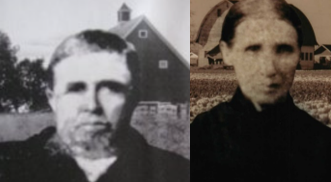
Catherine (née Long) & John Cullinane were a married couple from Ballymacoda who emigrated to the United States in the 19th century. From humble beginnings, the Great Famine forced them to emigrate in 1847, and they were to eventually become owners of a large tract of farmland in Illinois. Their surname ‘Cullinane’ would go through various changes in spelling on official documents of the time as we shall see, with it ending up being spelt as ‘Clinnin’ by the time John & Catherine passed away. This was not uncommon for the time given the low literacy rates, with many people who could spell, spelling a name as it was pronounced and thus a surname evolving in such a manner.

Both John (known as ‘the red’) and Catherine were born in Ballymacoda – Catherine in 1815, and John in 1817. Catherine was the daughter of James Long & Catherine Lee. John was the son of James Cullinane and Ellen McCarthy. The Ballymacoda Parish marriage records show that John & Catherine were married on June 14th, 1838.

Marriage record for John & Catherine, June 14th, 1838

In 1847, during the worst year of the famine, John, Catherine and family emigrated to the United States. The year is corroborated by an entry in the 1900 United States Federal Census, in which Catherine, now living in her daughter’s household since John’s passing, confirmed her year of arrival in the United States as 1847. Their arrival in the United States in 1847 is also corroborated by the first trace of the family we find in America in the historical record – this is in the 1850 United States Federal Census.

The data in this census, three years after their arrival, shows John & Catherine living in the Grafton Township in McHenry County, Illinois. John’s occupation is recorded as farmer. This region, having recently been settled, was originally settled as a farming community. Fertile fields and dedicated labour by emigrants led to abundant harvests, enabling local farmers not only to supply nearby creameries but also to ship milk to processing plants in Chicago. Grafton lies in the southern part of McHenry County, bordered on the south by Kane County, on the east by Algonquin, on the north by Dorr, and on the west by Coral. In the 1850 US census, John & Catherine are recorded as having three children – Ellen, Hannah, and Catherine. Also noteworthy in their 1850 US census entry, is that their surname is once again misspelt, this time as ‘Clynnen’ – here we can start to see the progression in the morphing of the surname from ‘Cullinane’ to its final ‘Clinnin’ – with the latter still being used by the many descendants of John & Catherine today.

Fast forwarding ten years to the 1860 United States Federal Census, we find our next trace of the lives of John & Catherine. By this time, they are living in Rutland Township, in Kane County, a little south of where they were previously recorded as living in the 1850 census. John is again recorded as a farmer, and it is possible that the move south was due to better opportunities to procure land – his obituary refers to him owning 200 acres in that area by the time of his death. The obituary of their daughter Mary in 1910 also mentions that John & Catherine were ‘among the earliest settlers of Rutland township, obtaining their land from the government’. Their location remains the same in the 1870 United States Federal Census, and by this time five children are listed as present – Catherine (aged 21, a dressmaker), James (aged 19, a farm hand), Mary (aged 17, whose occupation was recorded as ‘housework’), and John (aged 13) and Margaret (aged 9), whose occupations were recorded as ‘at home’. The oldest children – Ellen and Hannah are not recorded in the 1870 US census entry, likely because they no longer lived at home and now had their own families.

Likely, John and Catherine began their American journey with little more than hopes, dreams, and the determination to build a better life for themselves and their family in America, having left the hardship and poverty of the famine at home in Ireland. As recent emigrants, they may have started by renting or labouring on smaller plots of land, gradually learning which crops thrived and which methods brought greater yields. Over time, thrift, steady work, and an astute sense for opportunity likely enabled them to increase their holdings and livestock and invest their profits back into the farm. The favourable farmland in their chosen destination, combined with economic demands for dairy products in nearby Chicago, would have provided them with both stability and prosperity. As they raised their children, tended to livestock, and steadily expanded their acreage, John and Catherine’s reputation as successful landowners grew. By the time of their deaths, they were no longer simply emigrants from Ballymacoda making a go of it in a new country, but rather respected, wealthy figures who had helped shape the community’s agricultural landscape and left a legacy that extended through multiple generations of their descendants.

John Clinnin died on July 3rd, 1884. His obituary, seen below, was carried in local newspapers, ensuring that news of his passing reached a wide audience in the surrounding community.
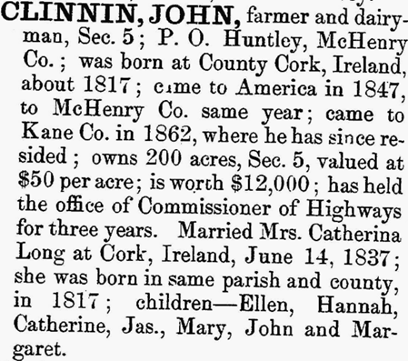
By this time, it was mentioned that he owned 200 acres of farmland and was worth $12,000, a considerable sum of money for that period. Such an amount would have placed him comfortably among the more affluent members of society, reinforcing the notion that his estate and possessions were well beyond the common standard of wealth. This notable financial standing, coupled with the substantial size of his landholdings, indicates that John Clinnin held an elevated position within the social and economic fabric of his era. It was also noted in his obituary that John had held public office as Commissioner of Highways for three years.

After John’s death, Catherine eventually went to reside with one of their daughters, a move that likely reflected the changing circumstances of her later life and the close-knit family ties that provided comfort and stability. Catherine’s obituary not only serves as a record of her passing but also offers significant data regarding the fate of the couple’s children. By the time Catherine died on August 10th, 1902, only four of their children were still alive, a poignant reminder of the era’s elevated mortality rates and the fragility of life on the American frontier. Both Catherine and John were buried in Saint Marys Cemetery in Huntley.
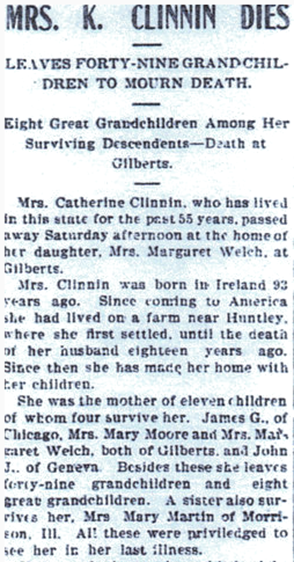
Furthermore, the obituary makes note of Catherine’s extensive lineage, citing a remarkable total of forty-nine grandchildren. One of these grandchildren, as we shall see later, was destined to play an especially notable part in preserving the family’s legacy, shedding further light on the enduring impact that these Ballymacoda emigrants had on their country of destination and the generations that followed.

Based on my research into John and Catherine Clinnin, it is likely that they were the ones who first introduced the ‘Clinnin’ surname to this region of America – as we have seen, this is a morphing of John’s original surname of ‘Cullinane’. There are countless examples of the generations that followed, right up to the present, using this surname. Another interesting find is that there is a laneway called ‘Clinnin Lane’ in the village of Huntley, just north of Rutland – I would be extremely surprised if this wasn’t named after a descendent of John & Catherine Clinnin from Ballymacoda.
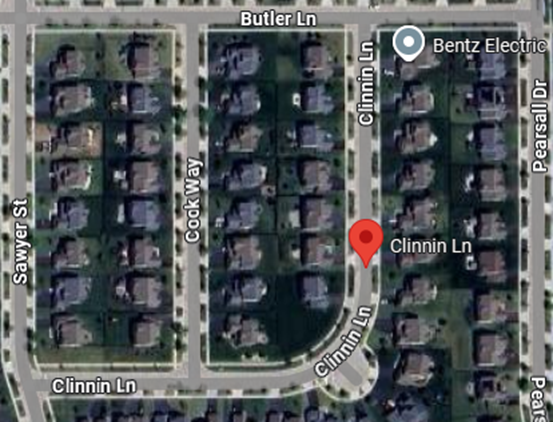
Clinnin Lane, in the village of Huntley, Illinois

The descendants of John and Catherine’s son, James Clinnin, would find themselves closely tied to numerous significant historical conflicts. James married Jane Dougherty, a native of Nantucket, Massachusetts, on New Years Eve 1874.

Their first-born son, John Vincent Clinnin (grandson of John & Catherine), would go on to become a well-known figure in Illinois and the United States in general. He was heavily involved in the sport of boxing, being at one time chairman of the Illinois Boxing Commission and president of the National Boxing Association. He was also an accomplished lawyer, who became an Assistant US Attorney, and practiced law in Chicago. He also ran unsuccessfully for the position of Lieutenant Governor of Illinois in 1936 and 1940.
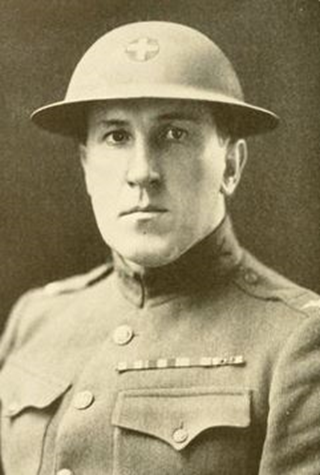
John V. Clinnin

But it is his wartime service that is probably most notable. He had a distinguished service in the US Army – being awarded the highest honours possible – the Distinguished Service Medal, a Bronze Star, and a Purple Heart. He was Commander of the 130th US Infantry during World War 1 and ultimately attained the rank of Major General. He died in September 1955 and was buried in Arlington National Cemetery in Virginia with full military honours.

The son of John V. Clinnin, John Vincent Clinnin Jr., also served the United States, fighting with the US Marine Corps during World War II and the Korean War. He also received a Purple Heart and also had the honour of burial in Arlington National Cemetery in Virginia. There are not many father and son pairs in US history who have both received a Purple Heart.
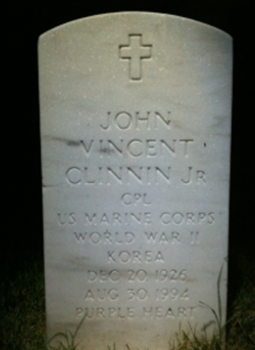
It is truly remarkable to consider that the descendants of two emigrants from Ballymacoda established such a distinguished record of service in the United States. From the quiet beginnings of a modest farming endeavour to the eventual accumulation of expansive landholdings, their journey embodies the promise and opportunity that America offered to those Irish emigrants who worked hard and took risks. Over time, these individuals would become deeply entwined with major historical conflicts, their contributions helping to shape the broader narrative of the nation. Their story, spanning multiple generations as we have seen, highlights the resilience, adaptability, and community-minded spirit that our emigrants often carried with them as they wove their legacy into the very fabric of American history.

Seen below, an article that carried in the Northwest Herald, in Woodstock, Illinois on Sunday, August 23, 1998, regarding a large Clinnin family reunion – all descendants of John & Catherine who left Ballymacoda in 1847 to seek a better life.
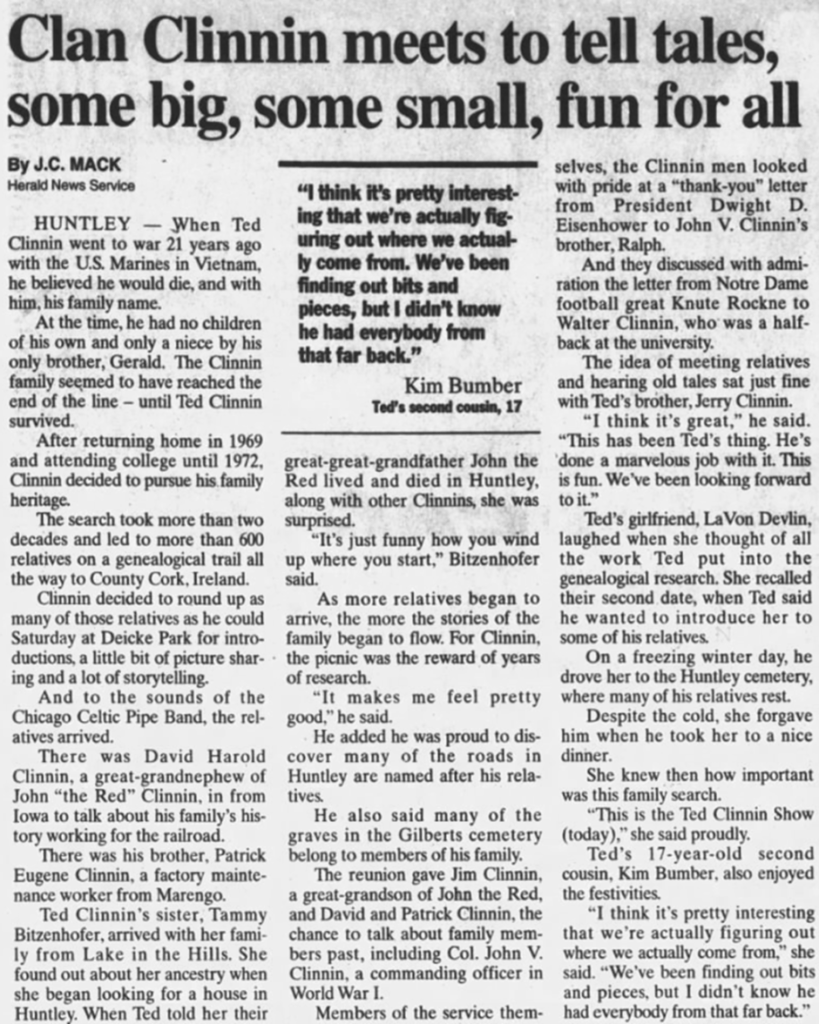
This carried in the Northwest Herald, Woodstock, Illinois, Sunday, August 23, 1998, Page 17

References & Further Information

Ballymacoda Parish Records

1850 United States Federal Census

1860 United States Federal Census

1870 United States Federal Census

1900 United States Federal Census

Google Maps

Northwest Herald, Woodstock, Illinois, Sunday, August 23, 1998, Page 17

Emigrant Stories: Thomas F. Russell

Taunton, Massachusetts, USA

Massachusetts emerged as a destination of choice for many Irish people in the 19th century due to numerous factors. Firstly, the state’s industrialization at that time offered many job opportunities, particularly in cities like Boston, where Irish immigrants found employment not only in the factories and the mills, but also in construction, domestic service, and the police and fire departments. In addition, Massachusetts had a well-established Irish American community that provided crucial support networks, including housing, work, and social connections, making the transition to a new country easier. The presence of the Catholic Church, which played a central role in Irish culture and identity, was also influential in attracting Irish immigrants to Massachusetts, where they freely practiced their faith. Thomas F. Russell from Ballymacoda was one of these such emigrants who made his way as a young man with his family to Massachusetts in the late 19th century.

Thomas F. Russell

Born in Ballymacoda in 1866, Thomas was the son of Thomas G. Russell (1843-1909) and Elizabeth ‘Betsey’ Quinn (1837-1912). Sources have listed Thomas as being born in 1867, but the Ballymacoda Parish baptismal records prove that he was born in 1866, as is evident from the record of his baptism, listed as having occurred on October 16th, 1866.

Baptismal record for Thomas Russell, with the names of his parents Thomas & Betty clearly visible

Even the gravestone of Thomas lists his birth year of 1867, but that does not seem to be correct based on the available parish records, which clearly show he was born and baptized in 1866. Thomas had five siblings – Elizabeth (1863-1942), Mary Jane (1864-1938), Michael (1869-1927), John (1871-1890) and Jeremiah (1874-1945). All were born before the family emigrated to the United States. The Russell family emigrated in 1882 when Thomas was about 15 years old, and settled in Taunton in Bristol County, Massachusetts, approximately 40 miles south of the city of Boston.

Thomas married Catherine ‘Kate’ Twiss in August 1890. At the time of their marriage, Thomas, aged 23, was a driver, and Kate, aged 20, was a mill operative. While from Providence, Rhode Island, Kate was the daughter of Irish emigrants Patrick & Kate Twiss. In the bustling streets of late 19th century America, it must have been an exciting time for the young Thomas & Kate, as they embarked on their journey in life surrounded by a vibrant tapestry of their fellow Irish expatriates, forging a path into an unknown future, where dreams probably seemed boundless in the ‘land of opportunity’. Thomas and Kate had three children – Lillian (1891-1897), Gertrude (1893-1983), and Thomas Leo (1894-1918). Lillian, their eldest child, tragically died of Meningitis while still very young.

The 1900 United States Federal Census shows Thomas, aged 33, living at 10 Russell Street in Taunton and listed as the head of the household. There is anecdotal evidence that Russell Street, which survives to this day in Taunton, was named as such because of the large number of families with the surname ‘Russell’ living there, but that is hard to verify as a fact. Thomas’s parents lived at nearby 6 Russell Street.

Today’s Russell Street in Taunton, Massachusetts

In the same 1900 Census document, Thomas’s wife Kate is also listed in the household along with John Twiss (Kate’s brother), and Thomas and Kate’s children Gertrude, then aged 7, and Thomas Leo (seen below), then aged 5. Young Thomas would later fight and die during World War 1. The Census document mentions that Thomas is a naturalized US citizen, and has been 18 years in the United States, which confirms the family’s emigration from Ballymacoda in 1882. Thomas’s occupation is shown as ‘Cloth Room’, which likely refers to a specialized section within a textile mill or factory where a variety of activities associated with fabric manufacturing took place.

A Young Thomas Leo Russell

In the 1910 United States Federal Census, Thomas, wife Kate, and son and daughter Thomas Leo and Gertrude are listed as living at the same address of 10 Russell Street in Taunton. However, Thomas now lists his age as 40, which doesn’t tally with his entry in the 1900 Census, or his actual birth year of 1866. Thomas lists his occupation as ‘Foreman’ and under industry lists ‘Car Barn’. A ‘car barn’ at the time was a building where trams, railroad cars, or buses were stored and maintained.

As often happens in life, tragedy struck Thomas and family in 1912. In April of that year, his wife Kate passed away suddenly at their home on 10 Russell Street due to a cerebral embolism. The grief must have been overwhelming, but fate had more sorrow in store just a few months later. In August, Thomas faced another devastating loss when his mother Betsey also died. She was 75 years old and lived just a few houses away at 6 Russell Street. This must have compounded Thomas’s sorrow, especially since his father had already passed away three years earlier in 1909. The series of losses likely left a lasting impact on Thomas, as he coped with the absence of the closest members of his family in such a short span of time.

Two years later, in April of 1914, Thomas found hope and companionship once more by remarrying. His second wife, Johanna O’Keefe, shared a similar background, being an Irish emigrant herself. Johanna was the daughter of Michael and Bridget O’Keefe, who had also made the journey from Ireland in search of a better life.

Around this time, the world was on the brink of World War I, the global conflict ignited by a complex web of factors, including rising tensions among the European powers, militarism, and the assassination of Archduke Franz Ferdinand of Austria-Hungary and his wife Sophie, Duchess von Hohenberg, in Sarajevo on June 28th, 1914, by Bosnian Serb student Gavrilo Princip. America joined the war in 1917, and the Selective Service Act of 1917 required all American males aged 21-31 years (later 18-45 years) to register to be potentially selected for military service. Thomas Leo Russell fell into this age bracket and was required to register in the draft. At the time he was working as a silversmith for the Reed & Barton company in Taunton (Taunton was known as the ‘silver city‘, due to it being a historic center of the silver industry beginning in the 19th century). He was selected for service in the draft and enlisted into the US Army as a Private on September 20th, 1917, initially serving in Company F within the 302nd Infantry Regiment, which was part of the 76th Division. In February 1918, he was transferred to the 3rd Company of the March Automatic Replacement Draft at Camp Devens, a training and mobilization camp located in Massachusetts.

WWI draft registration card completed by Thomas Leo Russell, his home address of 10 Russell Street in Taunton is clearly visible.

Thomas Leo’s military record next indicates that he started training within the 2nd Infantry Training Battalion and later moved to the 7th Company within the 1st Infantry Training Battalion. On March 12th, 1918, he was transferred oversees to France, as part of the 23rd Infantry Regiment, 2nd Division.

Oversees Transfer Record for Thomas Leo Russell, Hoboken, New Jersey, March 1918

Just a few months into his oversees service, Thomas Leo Russell was killed in action on July 1st, 1918, during the Battle of Belleau Wood in Northern France, in which 1,811 United States soldiers were killed. He was buried in the Aisne-Marne American Cemetery nearby (Plot A, Row 2, Grave 6). Back home in Taunton, when Thomas Russell received the heartbreaking news that his only son had fallen in battle, he must have been engulfed by a sorrow so deep that words could hardly capture its depth. The future he had no doubt envisioned, brimming with dreams and aspirations for his child, was suddenly and irreparably shattered. The pain was undoubtedly compounded by the fact that his son was buried in France, with no possibility of repatriating the body. Knowing that his final resting place was so far from home must have added an additional layer of heartache.

The death of Thomas L. Russell, reported in the Boston Globe on October 1st, 1918

A few years later, in his entry for the 1920 United States Federal Census, it seems that Thomas again lists his age incorrectly, as 50 (younger than he is). In this Census, there is no mention of wife Kate – as mentioned earlier, she had passed away in April 1912, and Thomas had remarried Johanna. She is listed on the Census as Hannah. Thomas’s daughter Gertrude, now 26, is listed, now working as a grocery store attendant. In this census, young Thomas is also absent, having died during World War 1 as we have seen.

Thomas F. Russell died in Taunton on Monday March 28th, 1927. His obituary lists him as having died ‘following an illness of two weeks’ duration’. He was survived by his wife Hannah, and daughter Gertrude. He was buried in Saint Joseph Cemetery in Taunton, where his parents had been buried earlier. Hannah lived until 1955, and Gertrude passed away in 1983.

A long line of descendants from the Russell family, who emigrated from Ballymacoda in 1882, still resides in this part of the world today. The legacy of the Russell’s continues to thrive, with each generation no doubt maintaining the connection to their Irish roots. There is no evidence to suggest that Thomas ever returned to Ballymacoda during his lifetime. This raises a poignant question about whether any of his descendants have made the journey back to their ancestral homeland. It would be fascinating to know if any of them have traveled to Ballymacoda, perhaps to walk the same street their forebears once did. The idea of reconnecting with their heritage, experiencing the culture, and witnessing the land that their ancestors called home might be a compelling and emotional journey for the descendants of the Russell family.

The gravestone of Thomas F. Russell, Saint Joseph Cemetery, Taunton

Seen below, the grave of Thomas G. Russell and his wife Betsey in Saint Joseph Cemetery in Taunton, the parents of Thomas F. Russell. You can see the reference to Ballymacoda at the base, this was common at the time for emigrant graves to mention their home parish.

References & Further Information

1900 United States Federal Census

1910 United States Federal Census

1920 United States Federal Census

Ballymacoda Parish Baptismal Records

Haulsee, W.M., comp.. Soldiers of the Great War. Vol. I-III. Washington, D.C.: Soldiers Record, 1920.

U.S., Army Transport Service Arriving and Departing Passenger Lists, 1910-1939

U.S., Headstone and Interment Records for U.S., Military Cemeteries on Foreign Soil, 1942-1949

American Battle Monuments Commission, Details for Thomas L. Russell

Michael Farrell – From Ballymacoda to the Crimean War

The Crimean War, in which the Russian Empire fought against an alliance of France, England, the Ottoman Empire and later the Kingdom of Sardinia between 1853 and 1856 was notable for a number of reasons. It has become known as the first modern global war, even often referred to as ‘World War Zero‘. It was also known as the first ‘media war‘ – in that there was widespread coverage in newspapers of the day, and huge interest amongst the general population. It is estimated that approximately 30,000 Irishmen fought in the conflict, and one of those was Michael Farrell from Ballymacoda.

Michael Farrell was born in Ballymacoda on January 8th 1835. After schooling he worked as a laborer for a period before signing up to the British Army on October 8th 1852 in Cork city, aged just 17. Michael initially served in 99th Lanarkshire Regiment, before being transferred to the 77th East Middlesex Regiment, serving with the rank of Private and carrying regimental number 2856.

In September 1854, after Britain had declared war on Russia, the 77th East Middlesex Regiment was sent to serve in Turkey and then Crimea, the British forces fighting alongside their allies from the French and Turkish armies. The 77th saw action fighting at the Battle of the Alma (September 1854), the Battle of Inkerman (November 1854) and the Siege of Sevastopol (October 1854 – September 1855). Michael Farrell was injured twice at the Siege of Sevastopol during 1855. His first wounding occurred on July 25th, and was minor. But on August 28th he was wounded by shell fragments which required the amputation of two fingers on his left hand. The Treaty of Paris, signed in 1856, brought an end to the Crimean War.

After the returning from the war, records show that Michael Farrell was discharged from the British Army at Chatham in Kent, on January 22nd 1856, having served just over three years. He was still a young man, aged just 21. For his service in the war, Michael Farrell was awarded the Crimea War Medal, a silver medal containing a bar for each of the battles he had been involved in. He was also awarded a pension of 8d. per diem (8 pence a day), which was to later increase to 9d. per diem in 1874, and 18d. per diem in 1903.

The Crimea War Medal. Bars for the battles of Alma, Inkerman and Sevastopol are visible at the top

The following year, having returned to Ireland, Michael married Catherine O’Brien, a native of Cappaquin, Co. Waterford. In 1858, Michael signed up to the Enrolled Pensioner Force (also known as the Pensioner Guards). This force consisted entirely of discharged soldiers on a pension, who would travel working as guards on prison ships bound for Western Australia. For Michael and his young wife, this meant free passage to Australia, and the added benefit of being eligible for a land grant in Western Australia after seven years of service had been completed.

Michael and Catherine were assigned to the convict ship the Edwin Fox, which coincidentally had been chartered by the British government to transport troops between Calais and the Baltic during the Crimean War.

The Edwin Fox left Plymouth on August 26th 1858 under Captain John Ferguson. Its destination was the Swan River Colony in Western Australia (what we know as Perth today). In addition to its convict cargo of 280, it carried 82 passengers including Michael and Catherine Farrell and 30 other men and their spouses of the Enrolled Pensioner Force. The ship arrived in Fremantle on November 20th 1858 after a voyage of 86 days.

The Edwin Fox, the ship on which Michael and Catherine Farrell emigrated to Western Australia. Today it is on display in Picton, New Zealand as a tourist attraction

Michael and Catherine settled in the town of Geraldton about 400km North of Fremantle, and he continued his work in the Enrolled Pensioner Force as a Prison Warder. They had at least ten children: Mary Jane (born 1859), Michael Jr. (born 1862), Margaret (born 1864), Ellen (born 1866), Edward (born 1869), William (born 1871), Mary Ann (born 1874), Lancelot (born 1876), Patrick (born 1876), and Katherine (born 1885).

In 1868, Michael Farrell was awarded a land grant at the Greenough Flats, just South of Geraldton. According to the records he was awarded locations ‘G36’ & ‘G37’, comprising of 20 acres each. Records indicate that this may have been a partial grant/purchase, in that Michael paid for a portion of the land in addition to the grant awarded as part of his earlier work in the Enrolled Pensioner Force.

Excerpt from the land grant awarded to Michael Farrell

Michael worked farming this land at Greenough for a period, but there is evidence he later worked as a lead miner which was a prevalent industry in the area. This may be because of some of the natural disasters that impacted the Greenough Flats in the ensuing years. Located on a flood plain, the flats were more susceptible to these events, and a major cyclone in 1872 and major flooding in 1888 contributed to the gradual decline in the number of settlers in the area.

Michael Farrell died in 1914 in Geraldton, a long way from his place of birth. In his life had been a soldier in the Crimean War, a guard on a prison ship bound for Australia, a farmer, and a lead miner. Catherine died 2 years later in 1916.

News of Catherine Farrell’s death, carried in the Geraldton Guardian, January 13th 1916

The thousands of descendants of Michael Farrell from Ballymacoda and his wife Catherine continue to live in Western Australia, and I wonder if they know of the village in East Cork where their ancestor came from?

References & Further Information

Crimean War Veterans in Western Australia, Record for Michael Farrell

UK, Royal Hospital, Chelsea: Pensioner Soldier Service Records, 1760-1920

UK, Royal Hospital, Chelsea: Regimental Registers of Pensioners, 1713-1882

UK, Military Campaign Medal and Award Rolls, 1793-1949

Enrolled Pensioner Force, Western Australia

Enrolled Pensioner Force, Western Australia, Record for Michael Farrell

The Edwin Fox Ship and Visitor Centre

Australia, Birth Index, 1788-1922

Western Australian Pioneer Index, 1841-1905

Pensioner Land Records, Government of Western Australia, Department of Local Government, Sport and Cultural Industries

Wikipedia Entry for Greenough, Western Australia

Searching for Missing Friends: Ballymacoda Emigrant Advertisements in the Boston Pilot

With mobile technology being pervasive today, it may be difficult for us to imagine a time where we cannot almost instantly connect with a family member or friend, be they in the next room, town, or on another continent. Such communication posed a more difficult challenge in the past, when historical events such as the Great Famine forced our people to emigrate en masse and seek a new life. This coupled with an immature international postal system, meant that family and friends lost contact, often for years at a time.

The Boston Pilot, founded in 1829, is a Catholic newspaper and since 1908 the official newspaper of the Archdiocese of Boston. It was an important newspaper from the perspective of Irish emigrants in the 1800s, becoming the voice of Boston’s Irish community by 1850.

From 1831, and for the next 90 years, the ‘missing friends‘ column of this newspaper was a popular mechanism of attempting to find information on missing family and friends in the United States. In this time, approximately 45,000 advertisements were published seeking information on missing people.

The first ad published in the Boston Pilot in October 1831 seeking information on a missing person

Through researching these ads, there is valuable insight to be gained with regards to Ballymacoda, which was no exception to the rest of Ireland in terms of emigration. There are literally 1000s of records of migrants to the United States in particular, and it is easy to see how families and friends lost contact.

A sample of locations where emigrants from Ballymacoda ended up in the 1800s (not all data and showing only the North-Eastern United States)

The first ad in the Boston Pilot referencing Ballymacoda and seeking information on a missing person was published on August 27th 1853 by John Ray, seeking information about his brother William.

Boston Pilot, August 1853

The next ad referencing Ballymacoda is five years later, when Mary Foley, of Thompsonville, Connecticut seeks information on her brother Patrick Leahy and a man named John McGrath, presumably his travelling companion.

Boston Pilot, Volume 21, Number 21, 22 May 1858

Ten years pass before we find another reference to Ballymacoda, when Patrick Power seeks information on his sister Honoria from Glenawilling, last heard from seven years previously and living in Boston with her uncles.

Boston Pilot, Volume 31, Number 13, 28 March 1868

In the 1870s and 1880s, there was a large increase in the number of ads seeking information on people from Ballymacoda. An ad seeking information on Patrick Kelly & family was published in three consecutive issues of the Pilot on March 9th, 16th and 23rd in 1872.

Boston Pilot, Volume 35, Number 10, 9 March 1872

The same cadence of ads over three issues was also seen seeking information on James Gleeson of Ballydaniel in November 1874.

Boston Pilot, Volume 37, Number 48, 28 November 1874

Information was also sought about John Ahern from Ballymacoda in 1874, who was last heard from ten years previously, living in Virginia at that time.

Boston Pilot, Volume 37, Number 48, 28 November 1874

In 1878, Mary Cronin was seeking information on her brother Daniel. Often times these ads were used to attempt to connect new emigrants with family members who had emigrated in years past.

Boston Pilot, Volume 41, Number 17, 27 April 1878

In November 1880, Patrick Lawton, the nephew of William and David Fehilly from Ballymacoda, who emigrated ‘some 20 or 24 years ago‘ seeks information on them.

Boston Pilot, Volume 43, Number 46, 13 November 1880

The longest ad found in my research concerns David Hyde from Lisquinlan, and was published in the Christmas Day 1880 edition of the newspaper by his brother Nicholas, and again in a January 1881 edition.

Boston Pilot, Volume 43, Number 52, 25 December 1880

In June 1881, an ad seeking information on Elizabeth and Margaret Cullen who had emigrated from Ballymacoda 19 years previously is published.

Boston Pilot, Volume 44, Number 23, 4 June 1881

The final two ads published in the Boston Pilot seeking information on emigrants from Ballymacoda were published in 1885 and 1886. In 1885, the sister of John O’Neill (who interestingly is noted as a grandnephew of Fr. Peter O’Neill) looks for information on her brother who was last heard from 32 years previously. This ad was published in two issues of the Pilot in July and August 1885.

Boston Pilot, Volume 48, Number 29, 18 July 1885

The final ad relating to Ballymacoda was published in September 1886 with information being sought on John Maguire and his wife who had emigrated to Boston 39 years previously (this is the longest timespan observed in any ad relating to Ballymacoda).

Boston Pilot, Volume 49, Number 38, 18 September 1886

One has to wonder if any of the ads were successful, and how often family and friends were reunited as an outcome. It is certain that the individuals being sought were important to the submitter of the ad – the cost of $3 dollars to publish such an ad in the Pilot was likely a sizable chunk of their regular income.

As well as providing a fascinating insight into the past, these ads in the Boston Pilot have been a rich source of genealogical information over the years based on the information they contain, and it is easy to see why, using these ads relating to Ballymacoda as an example. Key information is present, such as dates of emigration, last known locations, ships travelled on etc. – all of which can be cross-checked and validated with other available records to help build out a picture of an emigrants life after leaving Ireland.

References & Further Information

Boston College Libraries, Boston College Newspapers Archive

The Irish Classifieds, A lost-and-found for the American Migration, Boston College Magazine, Spring 2005 Edition